
A shea butter batch that cools slowly on a warm bench will often feel gritty a day later, even with a flawless ingredient list. Cooling rate decides whether the fat sets smooth or sandy, so it is the first thing to control in any method for how to make body butter. Below is a bench-scale method, followed by what changes when the recipe moves to a contract manufacturer.
Why Batches Turn Grainy
Grainy body butter comes from uneven fat crystallization, not from a wrong ingredient list. Shea butter holds several fats that solidify at different temperatures. When they set slowly or separately, the higher-melting fractions form larger crystals that feel like sand on the skin.
Shea butter and fatty acid behavior
Shea butter (INCI: Butyrospermum Parkii Butter) is a mix of triglycerides with different melting behavior. Melt it only partly and tiny crystal seeds survive, then grow as the batch cools. Reheating a finished jar unevenly does the same, as does leaving a batch to cool in a warm room. Cocoa butter and mango butter behave much alike, each with its own firmness and set point.
What the finished texture should look like
A good batch looks uniform, opaque and satin-like, with no visible specks. Rub a small amount between two fingers: it should melt evenly and leave nothing gritty behind. If you feel grains, correct the batch before filling anything.
What Ingredients Do You Need to Make Body Butter?
A basic body butter needs a solid butter for body and a liquid carrier oil for spreadability. An extra emollient and fragrance are optional. A preservative is optional too, until any water is present. Each choice changes feel, firmness and what the label can say.
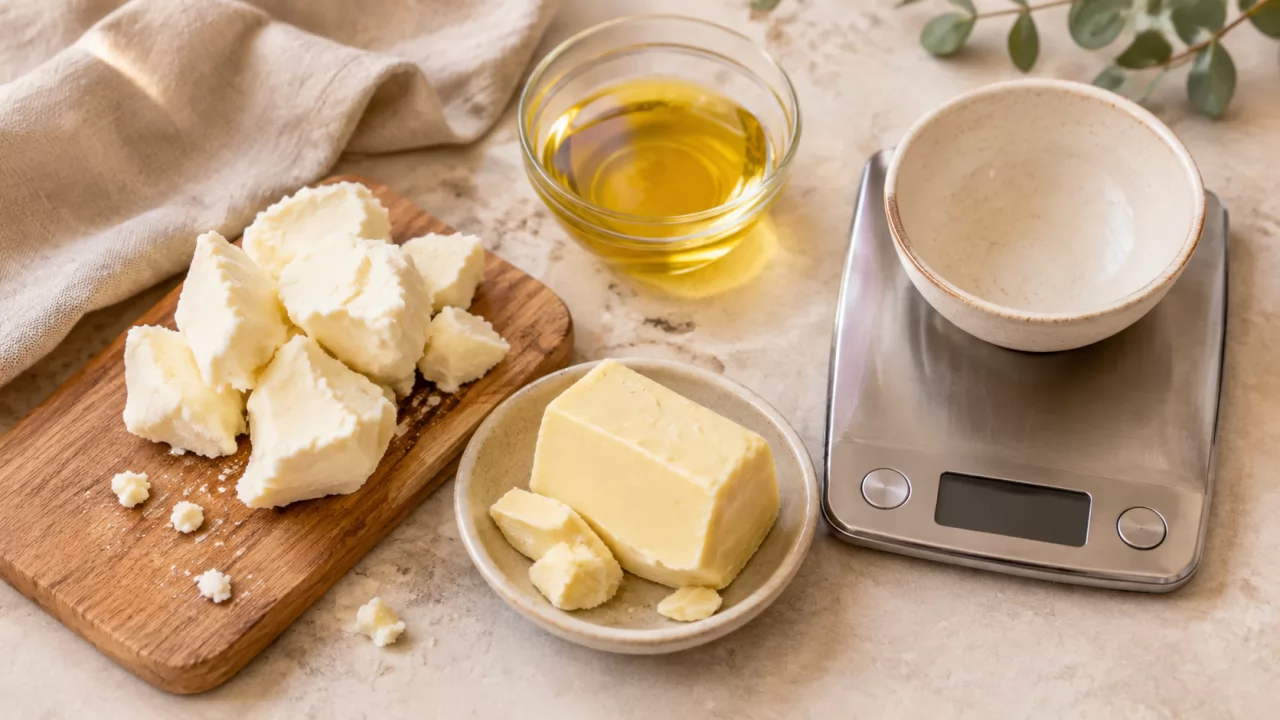
Butters and carrier oils
The table compares common choices by feel and typical role. Descriptions are general and vary by supplier and refining grade.
| Ingredient (INCI) | Feel | Firmness | Typical use |
|---|---|---|---|
| Shea butter (Butyrospermum Parkii Butter) | Rich, creamy | Medium to firm | Main body of the formula |
| Cocoa butter (Theobroma Cacao Seed Butter) | Dense, slightly waxy | Hard, brittle | Adds firmness in small amounts |
| Mango butter (Mangifera Indica Seed Butter) | Smooth, less greasy | Medium | Lighter alternative to shea |
| Sweet almond oil (Prunus Amygdalus Dulcis Oil) | Light, quick to spread | Liquid | Softens and improves glide |
| Coconut oil (Cocos Nucifera Oil) | Light, melts on contact | Soft solid in cool rooms | Softens, but can melt in heat |
Shea with a light liquid oil suits most whipped formulas. Cocoa butter firms a formula up; it is not a base.
Essential oils and fragrance
Essential oils need care. Many contain fragrance allergens that some markets require on the label, and some people react to them. Keep levels low, record what went in, and patch-test the finished product before wider use.
Preservation and water content
An anhydrous butter, made only of fats and oils, does not support microbial growth the way a water-containing cream does. Add water, hydrosols or aloe and you need a validated preservative system and different handling. That choice also sets shelf life and the testing a manufacturer will ask for.
Tools and Prerequisites
You need a digital scale, a heat-safe bowl over a water bath, a thermometer, a mixer, a spatula and clean jars. Sanitize tools and containers with isopropyl alcohol and let them dry. Keep a notebook per batch: ingredient lots, weights, melt temperature, cooling time, room conditions.
Tip: Weigh every ingredient rather than measuring by volume, since butters pack unevenly in a cup. Log each batch so a good result can be repeated and a bad one traced.
Phase One: Melt and Blend
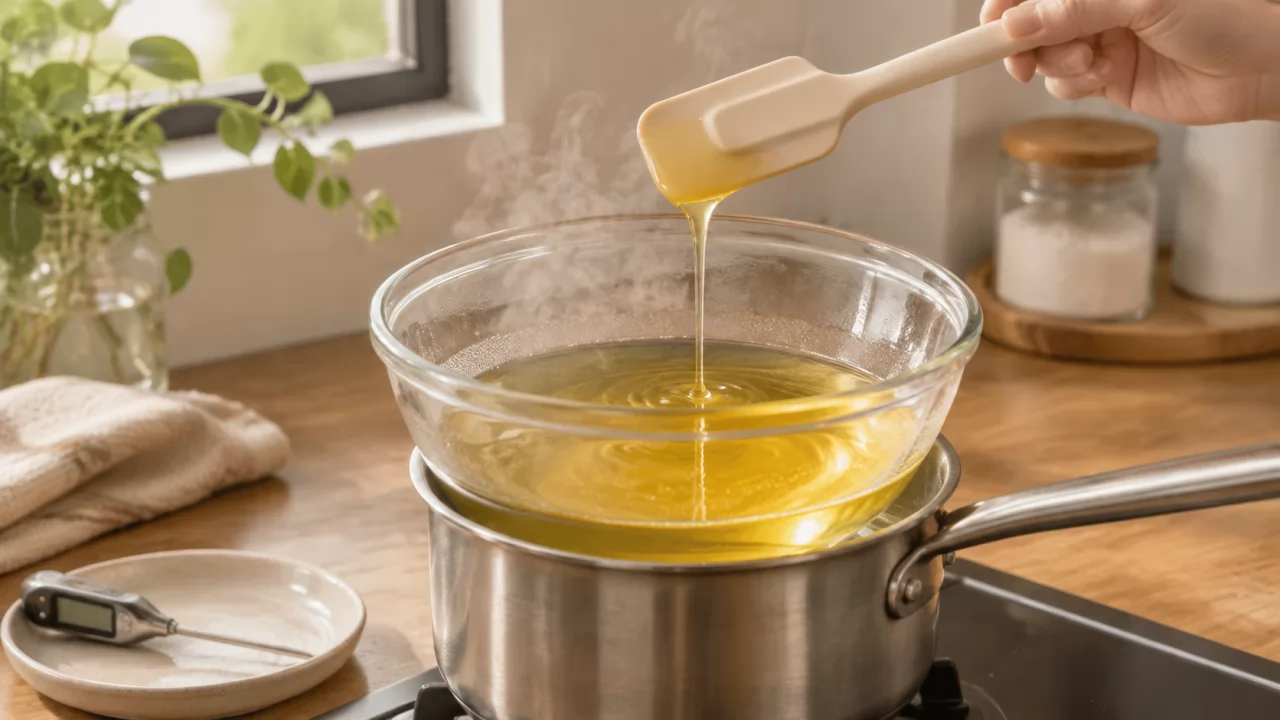
The aim is a fully melted, clear, uniform oil phase with no solid seeds left.
Weighing and gentle heating
Combining butters with oils
- Weigh everything first. Errors found mid-melt are hard to correct without reheating.
- Melt the hardest butters gently over a water bath. Direct heat scorches butter and can damage its smell.
- Hold until completely clear. Any cloudiness means crystals remain, and they seed graininess later.
- Stir in the liquid oils. This lowers the temperature slightly and evens the blend.
Phase check
Lift the spatula: the liquid should be transparent, free of specks and uniform. If it looks cloudy, heat a little longer while stirring.
Phase Two: Chill and Whip
Texture is decided here. To make whipped body butter with shea butter, cool the melted blend quickly and evenly to a soft-set stage, then whip until it holds peaks. In a homemade body butter recipe, that sequence matters more than exact proportions.
Chilling to the soft-set stage
Put the bowl in the refrigerator or over an ice bath, stirring at the edges so the mixture sets evenly. Fast, even cooling favors small crystals. Aim for an opaque, slightly firm paste around the rim with a soft center, not a hard block.
Whipping and adding fragrance
Start the mixer slowly and whip until the mass turns pale and fluffy and holds peaks. Add fragrance or essential oils near the end, once the mixture is cool, so volatile notes are not lost to heat.
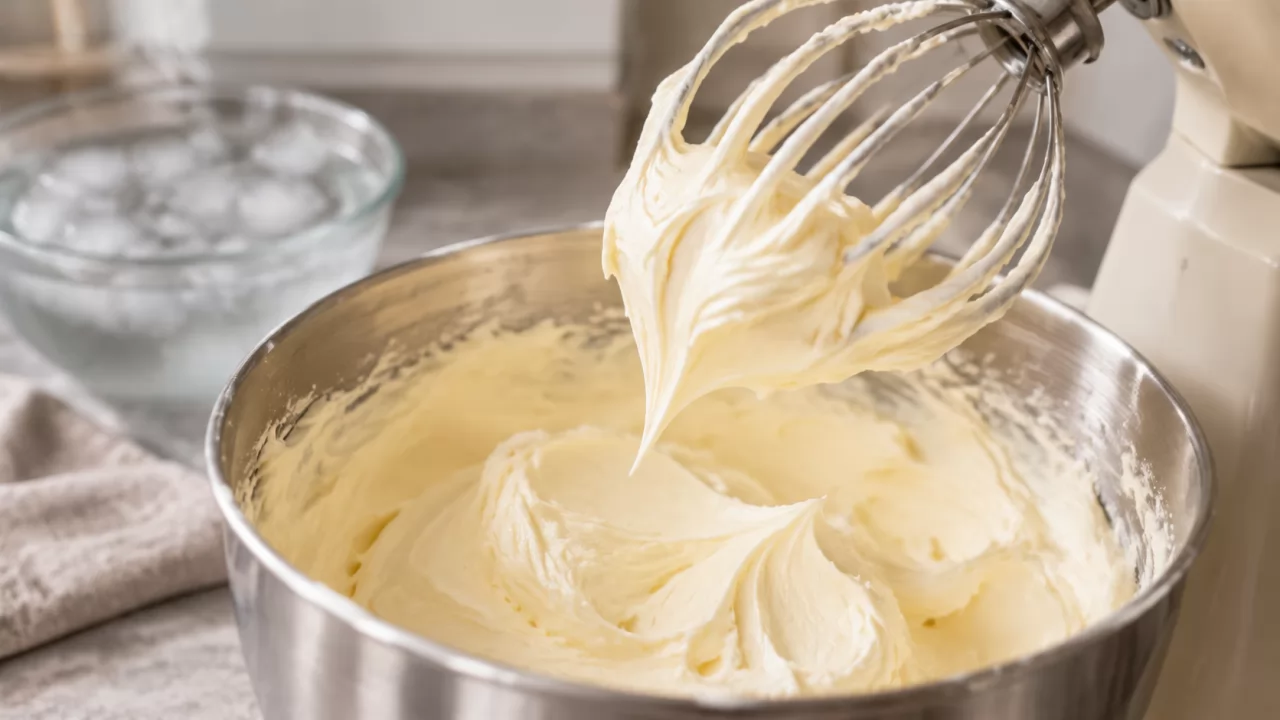
Note: Do not whip while the mixture is still liquid; it will not hold air and may turn greasy. Fragrance goes in at the cooled stage, never into hot oil.
What to watch for at each stage:
| Stage | Purpose | Visual cue |
|---|---|---|
| Melted blend | Erase crystal memory | Clear, no cloudiness |
| Chilling | Form fine crystals | Opaque rim, soft center |
| Whipping | Add air, build structure | Pale, peaks form |
| Fragrance | Scent without heat loss | Mixture fully cool |
| Rest | Confirm stability | Smooth, peaks hold |
Go by the cues, not the clock; room temperature and batch size change the timing.
- Chill with stirring. Even cooling keeps crystals small.
- Whip to stable peaks. Stop once the texture is uniform, or you risk overworking it.
- Fold in fragrance. Do it last, and briefly.
Phase check
Peaks should hold their shape. After a rest the surface should stay smooth, with no weeping oil and no gritty feel.
Phase Three: Fill, Label, Test
A good batch can still fail at filling, through heat, contamination or packaging that does not suit the formula.
Jars, tubes and fill temperature
Fill whipped butter into jars once it is firm enough to hold peaks. Tubes suit softer, less aerated formulas. Check that the plastic is compatible with oils, since some types soften or absorb fragrance.
Stability and skin-compatibility checks
Store sample jars in warm and in cool conditions, and watch for separation, sweating, color change or a shift in smell. Patch-test with a small panel of volunteers under proper oversight. These checks are indicators, not proof of safety.
Labeling by target market
Labeling rules differ by market. Expect INCI ingredient lists, allergen declarations and batch codes, plus responsible-person or safety assessment requirements in places such as the EU. Confirm the rules for each destination before printing.
- Fill at a firm, workable stage. Warm product shrinks and sinks.
- Match the container to the formula. Oil-rich products can attack some plastics.
- Run stability and patch checks. Do this before any sale.
- Label to the destination market. Rules are not uniform.
Troubleshooting Common Defects
Most defects trace back to temperature handling or the butter-to-oil ratio.
| Symptom | Likely cause | Adjustment |
|---|---|---|
| Grainy | Slow or uneven cooling | Remelt fully, chill faster |
| Greasy | Too much liquid oil | Raise butter share |
| Sweating oil | Temperature swings in storage | Add firmer butter, store cool |
| Soft in heat | Low-melt oils dominate | Reduce coconut oil, add cocoa butter |
Change one variable per trial, or you will not know which fix worked.
Moving to Private Label Production
To make private label body butter, you hand a defined brief to a manufacturer, who scales the formula, fills it into your packaging and documents it. Bench recipes rarely transfer one to one: large batches cool more slowly and need different equipment and process control.
Specs to put in the brief
State the butter and oil base, target texture, fragrance direction, color, fill weight, container type and destination markets. Add any claims you plan to make, such as natural or vegan, since they affect ingredient choices.
Documents and compliance checks
Ask for an MSDS, a COA, a stability report and an audit report. Find out which quality system the plant works under; ISO 22716 is the one for cosmetic GMP. Poleview makes body lotion, face and body cream and body and hair oil under OEM, ODM and private label, and lists these documents as available.
Samples, MOQ and lead time
Cost is driven by packaging, fragrance, custom colors and order size. Free samples are offered. The standard MOQ is 1,000 units, with flexibility depending on customization, and production lead time runs 15-30 days depending on quantity and customization.
Note: Formula, fragrance, color and packaging can each be customized. Approve a physical sample before production starts.
FAQ
Can I make body butter without shea butter?
Yes. Mango, cocoa or kokum butter can replace it, though firmness and feel change, so adjust the oil ratio.
Why does my whipped body butter melt or separate in warm weather?
Usually because of low-melt oils or temperature swings. Fats soften and re-set unevenly; a firmer butter share and cool storage reduce it.
Does body butter need a preservative?
Not if it is anhydrous. Once water or water-based ingredients are added, a suitable preservative system is needed.
Can a manufacturer match my homemade body butter recipe?
Generally yes, though the formula is usually adjusted for scale and stability, so expect sample rounds.