
Most failed batches of homemade laundry soap fail for the same boring reason: the maker treated soap as a mixing exercise instead of a chemistry one. Grated bar soap plus washing soda works, but only if your water is soft enough and your dose is small enough — otherwise you're slowly coating every towel you own in a waxy film. Two routes actually deliver clean laundry, and this guide walks through both, including the one that involves lye and the one that doesn't.
- Safest beginner recipe: grated soap + washing soda + borax powder — no lye handling, ready the same day.
- Washing soda (sodium carbonate) is not lye (sodium hydroxide), and neither is baking soda. Confusing them is the single most common recipe error.
- Hard water quietly destroys soap performance. A water-softening booster matters far more than fragrance.
- Cold-process saponified bars need a 4–6 week cure before they touch fabric — rushing it leaves unreacted alkali in the bar.
- Selling changes everything: repeatable formulas, MSDS/COA documentation, and stability testing sit outside what a kitchen can produce.
Why Handmade Laundry Soap Is Worth the Effort (and Where It Falls Short)
The appeal is straightforward. You control every ingredient, you skip the plastic jug, and a batch of powder mixed in ten minutes covers weeks of washing.
The trade-offs are just as real. True soap — as opposed to synthetic detergent — reacts with calcium and magnesium in hard water to form insoluble soap scum. That scum has to go somewhere, and it usually goes into your fabric fibers and your machine's drum seal.
Commercial liquid detergents solve this with surfactants that don't react with hard-water minerals. Handmade soap can't match that chemistry. What it can do is clean well on light-to-moderate soil, in soft or softened water, at a materially lower cost per load.
The real cost-per-load math
Prices swing by region and by how you source ingredients, so treat these as a planning framework rather than gospel. The pattern holds even when the absolute numbers move.
| Option | Relative cost per load | Upfront time | Practical shelf life |
|---|---|---|---|
| Homemade powdered laundry detergent (grated soap blend) | Lowest — typically a small fraction of retail detergent | 10–20 minutes per batch | 12+ months if kept dry and sealed |
| Homemade cold-process laundry bar | Low, but oils cost more than soda ash | 1–2 hours active, plus 4–6 weeks curing | 1–2 years; hardens further over time |
| Commercial liquid detergent | Highest per load | None | Usually 6–12 months after opening |
One caveat worth stating plainly: if hard water forces you to add a softener to every load, some of that cost advantage evaporates.
Who this is (and isn't) for
If you wash mostly everyday clothing, linens, and towels in a top-loader with reasonably soft water, a homemade blend will serve you well. If your household produces motor oil, heavy grease, or clinical-level soiling, keep a commercial detergent on the shelf for those loads.
Entrepreneurs are in a different position entirely. A recipe that works in your laundry room is a proof of concept, not a product. The section on scaling covers that gap.
What You'll Achieve and What You Need First
Method 1 produces roughly 2–3 pounds of powder from a standard batch — somewhere around 60 to 80 regular loads at a tablespoon per load. It takes under twenty minutes and requires no protective equipment beyond avoiding a faceful of soda dust.
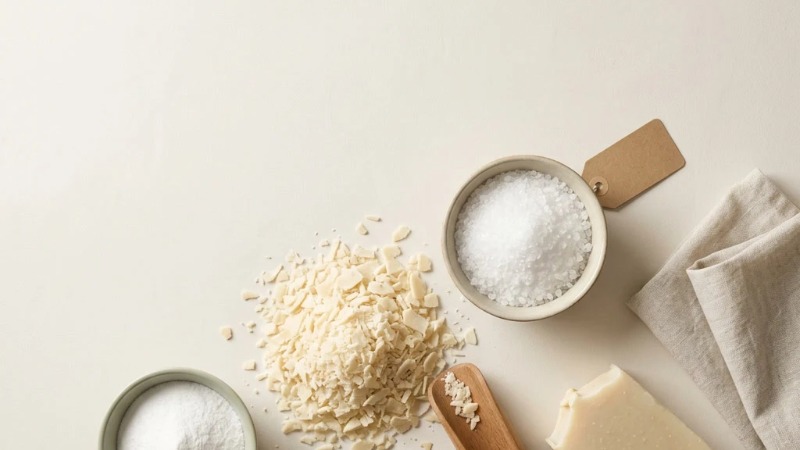
Method 2 produces a hard, long-lasting bar for pre-treating stains and hand-washing, plus grating stock for future powder. It takes an afternoon and six weeks of patience.
Skill and safety prerequisites
For the no-lye method: you need a grater, a bowl, and the discipline to measure rather than eyeball. That's it. Wear a dust mask if you're sensitive — washing soda is alkaline and the airborne powder irritates airways.
For cold process, the bar is higher. Sodium hydroxide causes severe chemical burns and reacts exothermically with water, releasing fumes for the first minute or two. You need splash goggles, chemical-resistant gloves, long sleeves, genuine ventilation, and a workspace with no children or pets in it. If that list feels like overkill, start with Method 1.
Understanding your water first
Test your water before you buy a single ingredient. Inexpensive hardness test strips give you a reading in seconds, and many municipal utilities publish hardness data in annual water quality reports.
Soft water, roughly under 60 ppm as calcium carbonate, lets soap perform close to its potential. Above about 120 ppm you're in moderately hard territory and need a softening booster. Very hard water — past 180 ppm — is where handmade soap starts losing to commercial detergent regardless of what you do.
Tools and Materials Checklist
Gather everything first. Stopping mid-batch to hunt for a scale is how mistakes happen, and in cold process it's how dangerous mistakes happen.
For the no-lye powdered recipe
| Ingredient | What it does | Typical quantity | Substitution |
|---|---|---|---|
| Bar soap or grated castile soap flakes | Surfactant — lifts oil and soil from fibers | 1 bar (about 4–5 oz), finely grated | Any unscented, dye-free true soap bar |
| Washing soda (sodium carbonate) | Raises wash-water alkalinity, helps break down grease and body oils | 1 cup | None — this is the workhorse |
| Borax (sodium tetraborate) | Water softening, pH buffering, brightening support | 1 cup | Sodium citrate or extra washing soda for a borax-free version |
| Oxygen bleach (sodium percarbonate) | Whitening and stain lift on colorfast fabrics | ½ cup, optional | Omit for delicates and wool |
| Essential oil | Fragrance only — no cleaning contribution | 15–25 drops, optional | Leave out for sensitive skin |
Equipment: a box grater or food processor, a large mixing bowl, a sturdy spoon, and an airtight container. A food processor with the shredding disc turns a bar into flakes in about fifteen seconds.
For the cold-process saponified bar
| Component | Role in a laundry bar | Notes |
|---|---|---|
| Coconut oil | High cleansing power, generous lather even in cooler water | Often the dominant oil in laundry bars; too much makes a skin-drying bar, which matters less for laundry |
| Tallow, lard, or palm | Hardness and longevity | Choose based on your sourcing values |
| Castor oil | Lather stability | Small percentage only |
| Sodium hydroxide (lye), 96%+ pure | Saponifies the oils into soap | Must be sodium hydroxide, not potassium hydroxide, for a solid bar |
| Distilled water | Dissolves the lye | Tap minerals cause unpredictable results |
Equipment: a digital scale accurate to 1 gram, an immersion blender, a heat-safe non-aluminum container for the lye solution, a thermometer, a silicone or lined mold, splash goggles, and chemical-resistant gloves. Aluminum reacts violently with lye. Never use it.
A quick note on sourcing and purity
Buy sodium hydroxide labeled for soapmaking at 96% purity or higher. Drain cleaner products often contain metal shavings or other additives that ruin a batch. Washing soda should be plain sodium carbonate with nothing else in the ingredient panel.
On fragrance: many fragrance oils are formulated for candles or diffusers, not for products that contact skin or fabric. Check that whatever you use is rated for the application, and skip fragrance entirely for baby clothes.
Method 1: No-Lye Grated Laundry Soap
This is where almost everyone should start. No caustic chemicals, no cure time, and you can test it on a load of towels tonight.
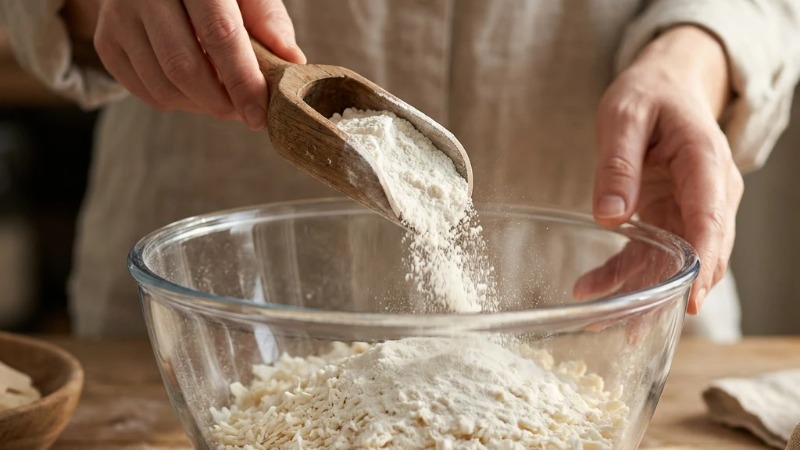
Step 1 — Grate or measure your soap base
Grate one bar of unscented soap on the fine side of a box grater, or measure out an equivalent volume of grated castile soap flakes. Fine matters here. Coarse shreds float, resist dissolving in anything below hot water, and reappear as white specks on dark fabric.
Verification: pinch a bit between your fingers. It should feel like coarse sand, not like ribbons.
Step 2 — Combine washing soda and borax
Add 1 cup washing soda and 1 cup borax to your grated soap. That roughly 2:1 ratio of boosters to soap is deliberate — it keeps actual soap content low, which is exactly what limits residue buildup.
Washing soda pushes wash-water pH up so grease and body oils release from fibers. Borax softens water by binding mineral ions and helps buffer pH across the wash cycle. Together they do more of the cleaning work than most people assume.
If you skip borax, increase washing soda modestly and consider adding sodium citrate for softening.
Step 3 — Add optional boosters and scent
Stir in ½ cup oxygen bleach if you wash a lot of whites and light colors. Sodium percarbonate releases hydrogen peroxide in warm water, which is why it does very little in a cold wash.
Fragrance is optional and easy to overdo. Fifteen to twenty-five drops of essential oil across a full batch is plenty, and much of the scent washes down the drain anyway. Anyone in the household with eczema or fragrance sensitivity is a reason to leave it out.
Step 4 — Blend, test-dissolve, and store
Mix thoroughly for a full minute. A food processor pulsed a few times gives a finer, more uniform blend that dissolves noticeably better than hand-stirring.
Verification test — do not skip this: drop one tablespoon into a cup of warm water and stir for thirty seconds. It should go cloudy with no floating soap flakes and no gritty layer on the bottom. Visible flakes mean grate finer next time.
Store in an airtight container away from humidity. Washing soda is hygroscopic — it pulls moisture from the air and turns a nice powder into a brick. A silica packet in the container helps in humid climates.
Step 5 — Dose it correctly per load
| Load type | Suggested dose | Notes |
|---|---|---|
| Standard top-loader, normal soil | 1 tablespoon | Add directly to the drum, not the dispenser |
| Standard top-loader, heavy soil | 2 tablespoons | Warm water helps significantly |
| HE front-loader | 1 tablespoon or less | Pre-dissolve first; monitor for residue |
| Cold water wash | 1 tablespoon, pre-dissolved | Dissolve in a cup of hot water before adding |
Under-dose before you over-dose. Excess soap is the root cause of nearly every residue complaint, and you can always add more next load.
Method 2: Cold-Process Saponified Laundry Bar
This makes real soap from scratch. It also involves a chemical that will burn your skin on contact. Read the whole section before you buy anything.
Understanding saponification in plain terms
Cold process soap saponification is the reaction between triglycerides in fats and sodium hydroxide. The lye splits the fat molecules, and what comes out the other side is soap plus glycerin.
The key point: properly formulated and fully cured soap contains no free lye. It's been consumed by the reaction. "Lye soap is harsh" is a leftover from an era of sloppy measurement, not a description of a correctly made modern bar.
Step 1 — Measure by weight and run the numbers
Every oil has a different saponification value, meaning each requires a different amount of lye. Volume measurements are useless here. Weigh everything in grams.
Run your oil weights through a reputable online lye calculator before mixing anything. Set a superfat of 0–1% for a laundry bar — unlike a skin bar, you do not want leftover free oils, because they deposit on fabric.
| Component | Example proportion by weight | Purpose |
|---|---|---|
| Coconut oil | ~70% of oil weight | Cleansing and lather |
| Tallow or lard | ~25% of oil weight | Bar hardness and longevity |
| Castor oil | ~5% of oil weight | Lather stability |
| Sodium hydroxide | Calculated — never estimated | Saponification |
| Distilled water | Roughly 2–2.5× the lye weight | Lye solvent |
Treat those percentages as a starting frame and let the calculator produce your actual lye figure. Do not copy a lye weight from anywhere, including this article.
Step 2 — Mix the lye solution safely
Goggles and gloves on. Work near an open window or under an extraction hood.
Always add lye to water, never water to lye. Reversing it can cause a violent, spattering reaction. Pour slowly, stir gently, and step back from the initial fumes — the solution will heat to near boiling on its own.
Let it cool to roughly 100–110°F (38–43°C). Melt and cool your oils to a similar range.
Step 3 — Combine, reach trace, and mold
Pour the lye solution into the oils slowly. Blend with an immersion blender in short bursts, alternating with hand stirring to avoid air pockets.
Watch for trace: the mixture thickens to the consistency of thin pudding, and a drizzle from the blender leaves a visible trail on the surface for a second or two. High-coconut recipes trace fast, sometimes in under a minute.
Pour into the mold, cover, and insulate with a towel. Leave it undisturbed for 24–48 hours, then unmold and cut into bars.
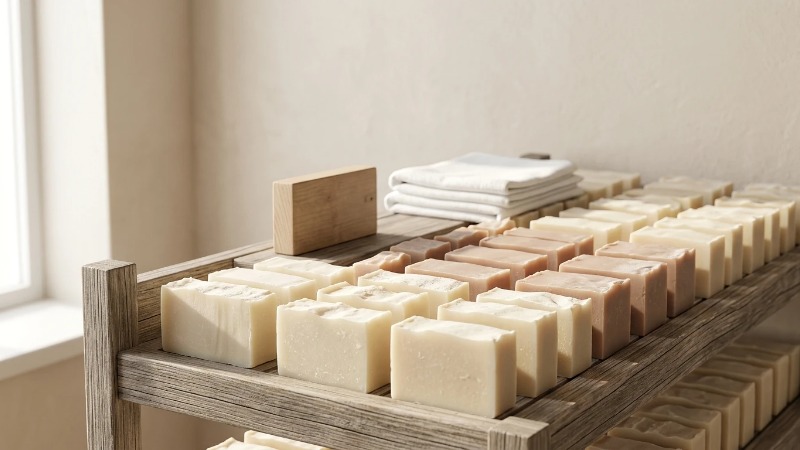
Step 4 — Cure for 4–6 weeks
Stand the bars on a rack with airflow on all sides. Saponification finishes in the first day or two, but the cure does two other things: it drives off water so the bar hardens and lasts longer, and it gives the chemistry time to complete fully.
Before first use, test with pH strips on a wet bar surface. A finished bar typically reads in the 8–10 range. Readings above roughly 11 suggest an incomplete reaction or a measurement error.
The old "zap test" — touching the bar to your tongue — is folklore, and it involves putting possible caustic on your tongue. Use strips.
Troubleshooting Common Problems
Soap won't dissolve or leaves white residue
Three usual suspects: water too cold, dose too high, or water too hard. Fix them in that order.
Pre-dissolve your tablespoon in a cup of hot water before adding it to a cold-water load. Cut your dose in half and see whether cleaning suffers — usually it doesn't. If residue persists, add ¼ cup of a water softener such as sodium citrate or washing soda to the load and rerun the test.
Clothes feel stiff, dingy, or smell off
That's buildup — soap scum bonded to fibers, sometimes with trapped body oils underneath. It develops over weeks, not one load.
Strip the fabric: run a hot wash with ½ cup washing soda and no soap at all, then a second hot rinse. White vinegar in the rinse cycle helps dissolve alkaline residue, but never combine it with oxygen bleach in the same cycle. Then go back to a lower dose permanently.
HE machine warnings and low-suds confusion
Low suds are correct. HE machines are designed for low-foaming formulas, and foam is not an indicator of cleaning power. Resist the urge to add more soap because the drum looks quiet.
The genuine risk with HE machines is residue in the drum, pump filter, and door gasket. Run the manufacturer's drum-clean cycle monthly, wipe the gasket dry after use, and check your warranty terms — some manufacturers are specific about detergent types.
My cold-process bar feels oily or caustic
An oily, weeping bar usually means too much superfat, an under-measured lye quantity, or separation from insufficient blending. Sometimes it rebatches successfully; often it doesn't.
A bar that stings skin or reads above pH 11 after a full cure should be discarded, not used. Don't gift it, don't "use it for rags," don't push it through another cure. Measurement errors with lye don't self-correct.
Pros and Cons: Homemade vs. Buying vs. Private Label
| Path | Advantages | Limitations |
|---|---|---|
| DIY powdered blend | Cheapest per load; ten-minute prep; full ingredient visibility; minimal packaging waste | Underperforms in hard water; residue risk if over-dosed; not a match for heavy grease or industrial soiling |
| DIY cold-process bar | Complete formulation control; excellent for pre-treating and hand-washing; long shelf life; satisfying craft | Requires lye handling and PPE; 4–6 week cure; batch-to-batch variance; a measurement error can ruin the batch |
| Private-label manufacturing | Consistent formula every run; certification and documentation handled; professional packaging and labeling; production capacity for real order volumes | MOQ commitments; less hands-on control over day-to-day production; lead times and upfront investment |
When DIY is the right call
Personal use, a household or two, soft or softened water, and a genuine interest in knowing exactly what's in the box. Those conditions make DIY a clear win.
When to stop making and start sourcing
Watch for these signals: you're spending weekends grating soap instead of selling it, customers report that batches differ, a retailer asks for a safety data sheet, or you need to state a shelf life you haven't tested. Each one means you've outgrown the kitchen.
Scaling From Kitchen Recipe to Sellable Product
Selling laundry soap is a different business from making it. The moment money changes hands, your recipe becomes a product subject to labeling rules, documentation expectations, and liability.
Compliance, labeling, and safety documentation
Requirements vary by market, but the pattern is consistent. Retail and export buyers routinely ask for a safety data sheet aligned with GHS classification and labeling, a certificate of analysis for each batch, and stability testing that supports whatever shelf life your label claims. In the EU, chemical ingredients fall under REACH obligations. Manufacturing quality systems such as ISO 22716 matter for personal-care crossover lines.
None of that is optional-nice-to-have paperwork. It's the entry ticket to shelf space.
Efficacy claims deserve particular caution. Saying a soap cleans is fine. Saying it disinfects, sanitizes, or kills bacteria turns it into a regulated product class in most jurisdictions, with registration and substantiation requirements attached. Never publish efficacy or safety figures you haven't tested.
Formulation consistency and MOQ realities
Home batches vary — oil temperatures drift, ambient humidity changes the cure, and a supplier swaps their coconut oil source without telling you. Customers notice. A bar that lathers differently in March than it did in January reads as a quality problem, even when both bars clean fine.
Commercial production solves this with locked specifications, incoming raw-material checks, and controlled environments. The other reality is minimum order quantity. Contract manufacturers price around production runs, so the per-unit cost that makes your margin work usually requires committing to volume you can't sell out of a farmers market stall.
How private-label manufacturing fits in
An OEM/ODM partner takes over formulation, testing, filling, and packaging while your brand keeps the customer relationship. You specify the ingredient profile, scent, color, dosage format, and label artwork; the factory delivers finished, documented, repeatable stock.
Poleview Group works this way across personal-care and cleaning formats — handmade soap, hair soap bars, cleaning tablets, bath salts, body wash, and related lines — through Boymay Cosmetics Co., Ltd. and Poleview Biotechnology Co., Ltd. Production runs in dust-free workshops with automated stamping, filling, labeling, and packing equipment, and formulations are built around natural, paraben-free, cruelty-free specifications. Documentation buyers ask for — GMPc, FDA, ISO 22716, audit reports, MSDS, COA, and stability reports — comes with the product rather than becoming your problem to chase.
For a founder deciding between another weekend of grating soap and building a brand, that division of labor is usually the honest answer.
Frequently Asked Questions
Is washing soda the same as baking soda or lye?
No — three different chemicals. Baking soda is sodium bicarbonate, mildly alkaline, useful for deodorizing. Washing soda is sodium carbonate, considerably more alkaline and the actual grease-cutter in a laundry blend. Lye is sodium hydroxide, a caustic chemical used to make soap, and it never goes into a wash load directly.
Can I use handmade laundry soap in an HE washer?
Yes, with conditions. Use roughly half the dose you'd use in a top-loader, pre-dissolve it in hot water first, and run the machine's drum-cleaning cycle monthly. Check your warranty documentation as well — some manufacturers specify detergent requirements, and residue-related damage may not be covered.
Does homemade laundry soap actually disinfect?
No. Cleaning and sanitizing are separate functions. Soap physically lifts soil, oils, and a portion of microorganisms off fabric so they rinse away, which is meaningful — but it is not the same as killing pathogens to a validated log reduction. If you need sanitizing for medical laundry, cloth diapers, or illness in the household, use hot water plus a product specifically registered for that purpose.
How long does homemade laundry soap last?
A dry powdered blend keeps well beyond a year in an airtight container, as long as humidity stays out. Moisture is the enemy, not time. A fully cured cold-process bar lasts a year or two and generally gets harder and longer-lasting as it ages. Discard either if you see mold, an off smell, or oil seeping from a bar.
Is DIY laundry soap safe for sensitive skin or babies?
It can be gentler than commercial detergent because you control what goes in — but "handmade" is not automatically hypoallergenic. Leave out fragrance and essential oils entirely for infant clothing and reactive skin. Wash one garment, then wear or use it for a day before converting the whole household. If anyone has diagnosed eczema or a known skin condition, ask their clinician before switching products.
Recap and Your Next Step
Start with the powder. One finely grated bar, a cup of washing soda, a cup of borax, mixed for a minute and stored dry — that's a working handmade laundry soap recipe you can test tonight without touching a caustic chemical. The mistake to avoid is the one nearly everyone makes: using too much. One tablespoon per load, pre-dissolved in cold-water washes, and a hardness test strip in hand before you blame the recipe.
If the bar route appeals, weigh everything, run a lye calculator, and give it the full six-week cure. No shortcuts there.
Ready to take it further?
Making it for your own household? Grate a bar this weekend, run the dissolve test, and start at half the dose you think you need.
Building a brand around it? The kitchen stops scaling faster than most founders expect. If you're developing a laundry bar, cleaning tablet, or personal-care line and need certified production, tested formulations, and complete documentation behind it, reach out to Poleview Group for samples, MOQ details, and private-label options — and put your energy into selling rather than stirring.