
Turning a skincare idea into a product people can buy is part science, part logistics, part patience. Maybe you're a founder sketching a serum on a napkin. Maybe you're a product developer scaling a concept that already works. Either way, the workflow follows a predictable path.
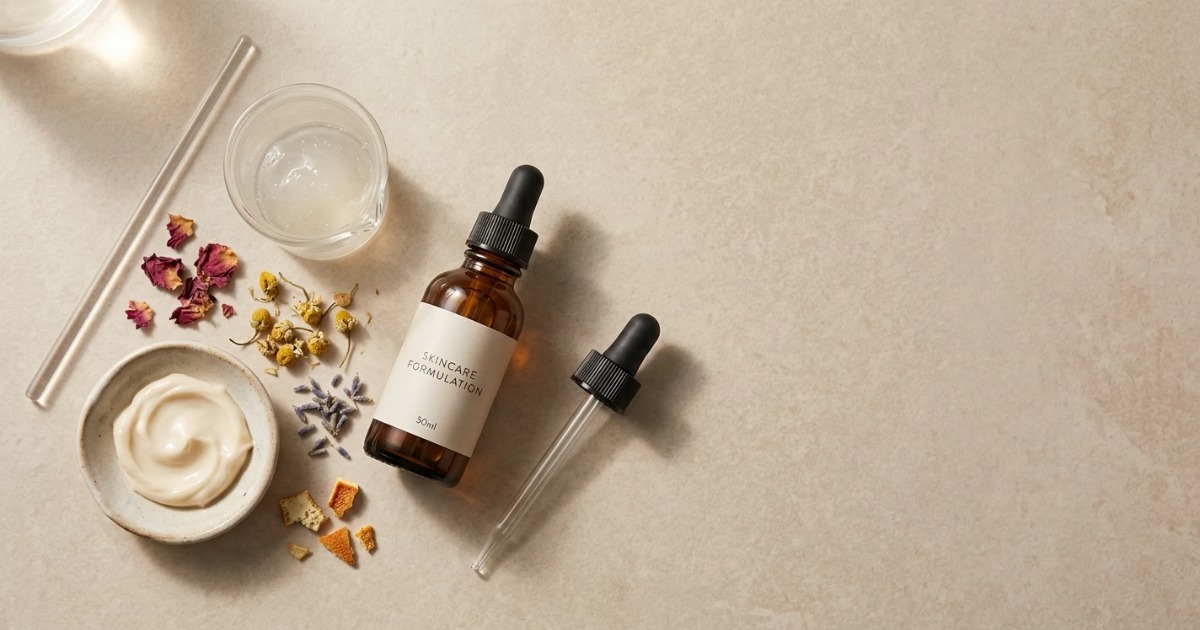
This guide walks that path end to end. You'll see where projects succeed, where they stall, and how good decisions early on save you months of rework later.
Understanding the Skincare Production Landscape
"Producing" skincare means far more than mixing ingredients in a lab. It covers concept work, formulation, testing, regulatory clearance, scale-up, packaging, and quality control.
Most projects stall in one of two places: underestimating the testing phase, or choosing the wrong production model. Both are avoidable once you understand your options.
In-House Production vs. Outsourcing to a Manufacturer
Building your own facility gives you total control. It also demands serious capital, technical staff, and a regulatory setup most new brands can't justify. You're paying for equipment, chemists, QC systems, and compliance long before your first sale.
Outsourcing to a contract manufacturer flips that equation. You rely on an existing facility, established formulas, and a team that already knows the compliance landscape. For brands without their own labs, a manufacturing partner like Poleview Biotechnology fills that gap, handling production while you focus on brand and market.
Key Roles in the Production Chain
A finished product passes through several sets of hands. Knowing who does what helps you communicate clearly and spot gaps in your project plan.
- Formulators and cosmetic chemists — translate your brief into a stable, effective formula.
- QC and QA teams — verify every batch meets specification and safety standards.
- Packaging suppliers — provide containers that protect the product and fit your brand.
- OEM/ODM partners — manage manufacturing, and in ODM's case, supply the formula too.
Table: Production Models Compared
| Model | Upfront Cost | Control | Speed to Market | Typical MOQ |
|---|---|---|---|---|
| In-House | Very high | Full | Slow | Any (you set it) |
| OEM (your formula) | Moderate | High on formula | Moderate | Medium to high |
| ODM (their formula) | Low | Moderate | Fast | Lower entry point |
Step 1: Define Your Product Concept and Formula Brief
Before anyone touches an ingredient, you need clarity on what you're making and who it's for. A vague idea produces a vague product.
Identifying Your Target Skin Concern and Audience
Pick one primary positioning and commit to it: anti-aging, sensitive skin support, deep hydration, oil control, or brightening. Trying to solve everything at once usually results in a product that solves nothing convincingly.
Tie that concern to a specific audience. A hydration cream for mature skin and one for acne-prone teens share almost no ingredients or messaging. The earlier you narrow this down, the sharper every later decision becomes.
Writing a Formulation Brief
A formulation brief is the document your lab actually builds from. The more precise it is, the fewer surprises you'll face during sampling.
Include your target texture (gel, lotion, rich cream), the active claims you want to support, a realistic price target per unit, and any preferred natural skincare ingredients. Note the deal-breakers too, like fragrance-free requirements or vegan certification.
Step 2: The Cosmetic Formulation Process
This is where your brief becomes a working sample. The cosmetic formulation process is iterative by nature, so expect a few rounds before you land on something you love.
Core Components of a Skincare Formula
Most skincare formulas are built from a handful of functional building blocks. Understanding them helps you read a formula sheet and ask smarter questions.
- Water phase — the base for most emulsions, carrying water-soluble ingredients.
- Oil phase — emollients and oils that condition and lock in moisture.
- Emulsifiers — bind water and oil into a stable, uniform product.
- Actives — the ingredients that deliver your headline claims.
- Preservatives — protect against microbial growth and extend shelf life.
- Sensory modifiers — adjust feel, absorption, and finish on the skin.
Choosing Between Natural and Synthetic Ingredients
Natural ingredients carry strong marketing appeal, but they can vary batch to batch and sometimes challenge stability. Synthetic ingredients often deliver consistency and cost efficiency, though they may not fit a "clean beauty" claim.
The honest answer is that most successful formulas blend both. Within the cosmetic formulation process, the goal is a product that performs, stays stable, and matches the story you're telling your customers.
Table: Common Skincare Ingredient Categories and Functions
| Ingredient Type | Example | Role in the Formula |
|---|---|---|
| Humectant | Glycerin, hyaluronic acid | Draws and holds moisture in the skin |
| Emollient | Squalane, shea butter | Softens and smooths the skin surface |
| Active | Niacinamide, retinol, vitamin C | Delivers targeted treatment claims |
| Emulsifier | Cetearyl alcohol | Keeps water and oil blended |
| Preservative | Phenoxyethanol | Prevents microbial contamination |
Prototyping and Bench Samples
Labs create small bench samples so you can evaluate texture, scent, color, and feel before committing to volume. Three to five rounds of refinement is normal.
Give specific feedback. "Too greasy," "absorbs too slowly," or "scent is too strong" tells a formulator far more than "I don't like it." Clear notes shorten the iteration cycle dramatically.
Step 3: Testing, Stability, and Compliance
This phase separates a hobby batch from a market-ready product. Skipping it is the single most common reason products fail after launch.
Product Stability Testing
Product stability testing confirms your formula stays safe and effective over its shelf life. Accelerated testing exposes samples to elevated temperatures to simulate aging quickly, while real-time testing tracks them under normal conditions over months.
Failures show up as separation, color shifts, odor changes, or a broken emulsion. Accelerated studies often run around three months. Full real-time validation can take a year or more, depending on your claimed shelf life.
Safety and Compatibility Assessments
Beyond stability, your product needs to be safe on skin and stable in its container. Several assessments cover this ground.
- Patch testing — checks for skin irritation and sensitization.
- Microbial challenge testing — confirms the preservative system holds up against contamination.
- Packaging compatibility — verifies the formula doesn't degrade or react with its container.
Regulatory Requirements by Market
Every market you sell into has its own rules, and documentation is your proof of compliance. The US FDA governs cosmetics with specific labeling and safety expectations, the EU requires product notification through the CPNP portal with a safety assessment, and China's NMPA has its own registration and filing requirements.
These frameworks shift over time, so verify against current 2026 guidance for each target market before you finalize anything. A good manufacturing partner will keep documentation audit-ready as part of the process.
Table: Sample Testing Checklist Before Mass Production
| Test Type | Purpose | Typical Duration |
|---|---|---|
| Accelerated stability | Predict shelf life quickly | ~3 months |
| Real-time stability | Confirm shelf life under normal conditions | 12+ months |
| Microbial challenge | Validate preservative system | ~1 month |
| Patch / skin safety | Check irritation and sensitization | 2–4 weeks |
| Packaging compatibility | Ensure formula and container coexist | Runs with stability |
Step 4: Scaling from Sample to Mass Production
A formula that works in a 200-gram beaker doesn't automatically work in a 500-kilogram batch. Scale-up is where good manufacturers earn their keep.
Understanding GMP Manufacturing Standards
GMP manufacturing standards, backed by ISO quality systems, exist to guarantee that every unit in every batch meets the same specification. They govern facility hygiene, equipment calibration, staff training, and documentation.
This matters because consistency is what customers trust. A cream that feels different from one jar to the next erodes a brand fast, and GMP practices are the safeguard against that.
Scale-Up Challenges
Mixing, heating, and emulsification all behave differently at volume. Heat transfers more slowly through a large tank, shear forces change, and an emulsion that held perfectly at bench scale can separate in production.
This is exactly where a manufacturer with large capacity and advanced processes reduces risk. Poleview Biotechnology, for example, produces under strict ISO quality standards, so formulas are scaled with the equipment and controls needed to preserve the sample you approved.
Batch Documentation and Traceability
Every production run should generate a batch record: what went in, when, at what conditions, and who signed off. Each batch gets a lot number tying it to those records.
Traceability isn't bureaucracy for its own sake. If a quality issue ever surfaces, lot-level records let you isolate the problem, support a targeted recall, and pass audits without scrambling.
Step 5: Packaging, Branding, and Private Label Options
Bulk product isn't a sellable SKU until it's in the right container with a compliant label. Packaging protects your formula and does a lot of your marketing.
Choosing Functional and Compliant Packaging
Packaging is a functional decision before it's an aesthetic one. Airless pumps protect sensitive actives like vitamin C from air exposure, jars suit thick creams but expose product to fingers and air, and tubes work well for gels and cleansers.
The wrong container can shorten shelf life or destabilize a formula that passed every test. Match packaging to your formula's needs first, then layer your brand design on top.
Private Label Skincare Production Explained
Private label skincare production lets you launch under your own brand using a manufacturer's existing, tested formulas and facilities. Instead of funding formulation and testing from scratch, you select proven bases, customize scent, packaging, and branding, and go to market faster.
For new and growing brands, this dramatically lowers upfront cost and risk. You're building on formulas that already cleared stability and compliance, which shortens your timeline considerably.
Labeling Requirements and Claims
Labels carry legal weight. Most markets require an INCI ingredient list, accurate net weight, batch identification, and any relevant warnings or usage directions.
Be just as careful with claims. Words like "cures," "heals," or unsupported "clinically proven" statements can reclassify your product as a drug or trigger regulatory action. Keep marketing language honest and backed by evidence.
Step 6: Choosing the Right Skin Care Manufacturer
Your choice of partner shapes quality, cost, and timeline more than almost any other decision. It's worth doing carefully.
What to Look for in a Manufacturing Partner
Strong candidates share a few traits: enough capacity to grow with you, credible certifications, genuine customization flexibility, an MOQ that fits your stage, and clear, responsive communication.
A great skin care manufacturer feels like an extension of your team rather than a black box you send orders into. Responsiveness during the sampling phase is often a good preview of the whole relationship.
Questions to Ask Before Signing
Before committing, put a few direct questions on the table:
- Can you provide samples before a full production run, and what do they cost?
- What are your realistic lead times from approval to delivery?
- What certifications do you hold, and can you share documentation?
- What's your minimum order quantity, and how flexible is it?
- What quality guarantees and testing come standard with each batch?
Table: Skin Care Manufacturer Evaluation Criteria
| Criterion | Why It Matters | What a Strong Answer Looks Like |
|---|---|---|
| Capacity | Supports growth without switching partners | Large, scalable production lines |
| Certifications | Proves quality and compliance | ISO and GMP with documentation |
| Customization | Lets your product stand out | Flexible formulas, scents, and packaging |
| MOQ | Determines entry cost | Reasonable minimums for your stage |
| Communication | Keeps projects on track | Fast, clear, English-capable support |
On these criteria, Poleview Biotechnology, based in Huizhou, Guangdong, checks the key boxes: high customization, competitive and well-organized pricing, ISO-compliant quality, and full OEM/ODM support for brands at different stages.
Common Mistakes to Avoid in Skincare Production
A few pitfalls trip up newcomers again and again. Knowing them in advance is the cheapest insurance you'll buy.
- Skipping stability testing — the fastest route to returns and complaints.
- Setting unrealistic MOQs — ordering too much of an unproven product ties up cash.
- Ignoring regulations — non-compliant labels and claims can pull a product off shelves.
- Underestimating packaging — the wrong container quietly ruins a good formula.
- Rushing the timeline — compressing testing to hit a launch date usually backfires.
Frequently Asked Questions
How much does it cost to produce a skincare line?
Costs vary widely based on formulation complexity, testing scope, packaging choices, and order volume. Private label routes lower the entry cost since formulation and testing are already done, while fully custom formulas require a larger investment. Higher order volumes bring down your per-unit price.
How long does it take to go from idea to finished product?
A realistic timeline runs from a few months to a year. Formulation and sampling take several weeks to a few months, stability and safety testing add three to twelve months depending on claims, and production plus packaging adds a few more weeks. ODM and private label paths are the fastest.
What is the difference between OEM and ODM?
With OEM, you bring your own formula and the manufacturer produces it. With ODM, the manufacturer provides a ready-made formula that you brand as your own. OEM offers more control; ODM offers speed and lower upfront cost.
Do I need my own formula to work with a manufacturer?
No. ODM partners maintain libraries of tested, ready-to-brand formulas you can customize with your own scent, packaging, and branding. This is the standard route for brands that want to launch quickly without funding formulation from scratch.
What certifications should a skincare manufacturer have?
Look for ISO quality certification and adherence to GMP manufacturing standards at minimum. Beyond that, confirm they can meet the compliance requirements of your specific target markets, whether that's FDA, EU CPNP, or NMPA documentation.
Start Producing Your Skincare Line
You now have the full map: from concept and formulation through testing, scale-up, packaging, and choosing the right partner. The gap between a planned product and a shelf-ready one is mostly execution, and the right manufacturer closes it.
Poleview Biotechnology is a personal care and skincare products manufacturer based in Huizhou, Guangdong, China, offering OEM and ODM services for brands worldwide. With large production capacity, advanced processes, ISO-compliant quality standards, high customization, and well-organized pricing, we're built to take your idea from brief to finished product.
If you're ready to move from planning to production, reach out to discuss your private label project. Let's talk about what you want to build, and how we can make it real.