

With China's soap export market exceeding $2.8 billion annually and growing at 7.3% CAGR, brands worldwide are turning to custom soap manufacturers in China to launch premium private label handmade soap lines. The opportunity is huge, but choosing the right manufacturing partner can determine whether your brand scales smoothly or struggles with quality, compliance, and delivery issues.
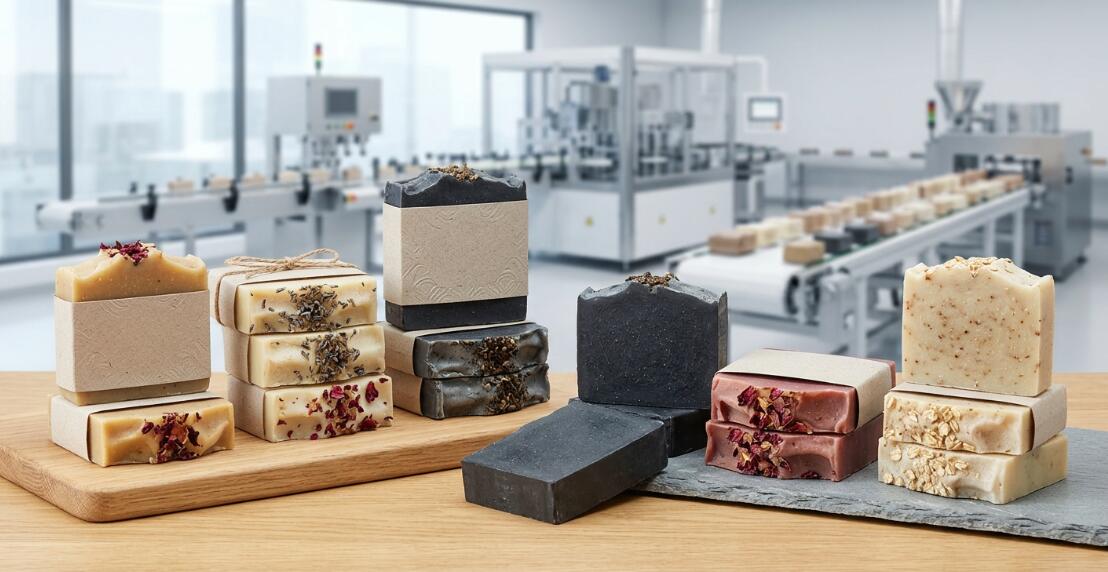
Why China Dominates Custom Soap Manufacturing
Scale, Cost, and Quality Advantages
China remains a global leader in soap and personal care production because it combines mature supply chains, specialized labor, and large-scale manufacturing infrastructure. For many brands, this translates into cost savings of roughly 30% to 60% compared with Western production, without sacrificing quality.
Today, OEM soap production China capabilities go far beyond low-cost manufacturing. Leading factories offer advanced formulation support, premium packaging, international compliance documentation, and automated production systems that help brands launch faster and more competitively.
The Rise of Private Label Soap Factory China Partnerships
DTC brands, retailers, spas, and subscription-box companies increasingly work with a private label soap factory China partner to accelerate product launches. Instead of building a factory from scratch, they use proven manufacturing systems for white-label, custom-formulated, and branded soap products.
This trend is also driven by consumer demand for natural, cruelty-free, and visually differentiated soaps. As a result, contract soap manufacturing services in China now commonly include custom scents, botanical ingredients, artisanal textures, eco-conscious packaging, and clean-label claims.
Key Soap Manufacturing Hubs in China
Major production regions include Guangdong, Zhejiang, and other industrial provinces with strong cosmetics and personal care ecosystems. These areas offer efficient access to packaging suppliers, raw materials, export logistics, and experienced technical teams.
Among the standout manufacturers is Poleview Group, a leading personal care products manufacturer in China. Poleview Group owns Boymay Cosmetics Co., Ltd. and Poleview Biotechnology Co., Ltd., and supports private label development for bath bombs, shower steamers, handmade soap, hair soap bar, bath salts, cleaning tablets, scented candles, face & body cream, body & hair oil, and face & body wash.
Types of Custom Soap Services Available
OEM vs. ODM Soap Production — What's the Difference?
| Feature | OEM (Original Equipment Manufacturing) | ODM (Original Design Manufacturing) |
|---|---|---|
| Formula | Client-provided or factory-developed | Factory-designed, client-approved |
| Packaging Design | Client supplies artwork | Factory offers design support |
| Minimum Customization | Label & packaging only | Full product concept development |
| Best For | Established brands with existing formulas | New brands needing end-to-end solutions |
| Turnaround | Faster (existing specs) | Moderate (R&D phase included) |
OEM is ideal for brands that already know what they want, including formula, fragrance, ingredients, and packaging style. ODM is better for businesses that need a factory to handle concept development, product design, and technical refinement.
Manufacturers such as Poleview Group provide both OEM and ODM services. Their capabilities cover product efficacy, ingredients, color, scent, packaging, and label printing, giving brands the flexibility to choose either a streamlined launch path or a fully bespoke approach.
Product Categories Beyond Bar Soap
Top manufacturers are no longer limited to standard bar soap. The best wholesale handmade soap suppliers now support a broad personal care portfolio, helping brands build cohesive product lines from one trusted source.
Poleview Group supports private label production for bath bombs, shower steamers, handmade soap, hair soap bars, bath salts, cleaning tablets, scented candles, face & body cream, body & hair oil, and face & body wash. This allows growing brands to expand from one hero product into a full bath and body collection with consistent quality and branding.
How to Evaluate Custom Soap Manufacturers in China
Essential Certifications to Verify
| Certification | What It Validates | Why It Matters |
|---|---|---|
| GMPc | Good Manufacturing Practice (Cosmetics) | Ensures consistent production quality |
| FDA Registration | U.S. market compliance | Required for selling in the United States |
| ISO 22716 | International cosmetics GMP standard | Recognized in 160+ countries |
| MSDS | Material Safety Data Sheets | Chemical safety documentation |
| COA (Certificate of Analysis) | Batch-level quality testing | Proves ingredient purity & potency |
| Stability Report | Product shelf-life validation | Guarantees product longevity |
| Audit Report | Third-party factory inspection | Verifies facility & process claims |
Certification review is one of the most important parts of supplier due diligence. Serious buyers should verify not only production quality standards, but also documentation that supports export, marketplace compliance, and customer safety claims.
Poleview Group holds all of the major credentials global buyers typically request, including GMPc, FDA, ISO 22716, Audit Report, MSDS, COA, and Stability Reports. This makes the company a strong option for brands that need a globally verified and compliance-ready manufacturing partner.
Factory Infrastructure & Production Capabilities
Modern soap production requires more than mixing ingredients. A reliable factory should have dust-free workshops, automated production lines, and quality machinery for stamping, filling, labeling, and packing to ensure consistency at scale.
Poleview Group operates with a dust free workshop and automatic production supported by high-quality machinery and mechanical equipment. This setup improves efficiency, reduces contamination risk, and helps maintain product consistency across large orders.
Formula Philosophy & Ingredient Standards
Consumers increasingly expect beauty and personal care products to meet clean-label standards. Natural Formula, Parabens Free, Cruelty Free, No GMO, No Chemicals, and Not Tested on Animals claims are becoming standard purchase drivers rather than premium extras.
Leading suppliers build their formulas around these expectations. Poleview Group’s products comply with Natural Formula, Parabens Free, Cruelty Free, No GMO, No Chemicals, and Not Tested on Animals, giving brands a strong foundation for modern market positioning.
Communication, MOQs, and Lead Times
Before choosing a manufacturer, ask clear questions about minimum order quantities, sample fees, development timelines, and communication workflows. Strong English-language project management is especially valuable when handling custom formulas, packaging revisions, and shipping deadlines.
Most factories set MOQs based on formula complexity and packaging type. Buyers should expect a sample stage, a confirmation stage, and then production scheduling, with timelines that vary depending on customization depth and order volume.
The Private Label Handmade Soap Production Process (Step-by-Step)
Step 1 — Concept & Formula Development
The first stage is defining your target customer, product positioning, ingredients, and sensory direction. This includes selecting scent profiles, active ingredients, colors, and the soap base type, such as cold process, melt & pour, or hot process.
At this stage, a skilled manufacturing partner can also advise on market trends, ingredient compatibility, and cost optimization. For brands using private label handmade soap manufacturing, early clarity reduces delays later in the project.
Step 2 — Sample Creation & Testing
After the brief is approved, the factory creates prototypes for review. These samples help confirm appearance, texture, fragrance strength, cleansing performance, and overall brand fit.
Testing may also include stability evaluation and supporting documentation such as COA. Reputable factories revise samples based on client feedback until the formula and presentation are approved for production.
Step 3 — Packaging & Label Design
Packaging is a major part of perceived product value. Brands can choose from custom molds, printed boxes, wrappers, shrink bands, labels, and gift-ready presentation formats depending on their market segment.
Regulatory label compliance also matters here. A good manufacturer helps ensure your labels contain the information required for your destination market, which can reduce customs and retail approval issues.
Step 4 — Bulk Production & Quality Control
Once samples and packaging are approved, the order moves into mass production. This stage can include stamping, cutting, curing, filling, labeling, and packing, depending on product type and packaging format.
Reliable factories use inline QC checkpoints throughout production. Automated lines and process controls help ensure each batch meets the approved standard in weight, appearance, scent consistency, and packaging quality.
Step 5 — Shipping, Customs & Compliance Documentation
The final stage includes export preparation, carton marking, shipping coordination, and document handling. Buyers should discuss HS codes, shipping terms such as FOB or CIF, and preferred freight methods early to avoid unnecessary delays.
Experienced Chinese manufacturers often support logistics coordination and provide the compliance documents needed for customs clearance and importer records. This is especially valuable for brands entering the US, EU, or regulated e-commerce channels.
Cost Breakdown — What to Budget for Custom Soap from China
| Cost Component | Typical Range (USD) | Notes |
|---|---|---|
| Formula Development | $0 – $500 | Often free with confirmed order |
| Sample Production | $50 – $200 per SKU | Refundable by some factories |
| Unit Cost (Handmade Bar Soap) | $0.50 – $3.00 per unit | Depends on size, ingredients, complexity |
| Custom Mold/Tooling | $200 – $1,500 | One-time cost |
| Packaging (Custom Box) | $0.10 – $1.50 per unit | Material & printing dependent |
| Shipping (Sea Freight) | $1,500 – $4,000 per container | Varies by destination & volume |
| Certifications/Testing | $300 – $2,000 | Per-product, per-market |
Custom soap pricing depends on your formula, packaging complexity, order volume, and testing requirements. Premium oils, essential fragrance blends, embossed shapes, and luxury gift packaging will increase unit costs, while larger production runs reduce per-unit pricing.
Working with a full-service manufacturer like Poleview Group can reduce total project spend by consolidating formulation, packaging, production, and compliance support under one roof. This simplifies coordination and often lowers hidden costs related to vendor fragmentation.
Common Mistakes When Choosing a Soap Factory in China
Skipping Factory Audits and Certification Checks
Some buyers rely only on product photos or online listings when selecting a supplier. This creates serious risk, especially when product claims, export compliance, and long-term reliability matter.
Always request third-party audit reports and verified certification documents. An established manufacturer should be able to provide these quickly and transparently.
Prioritizing Price Over Ingredient Transparency
The cheapest quote is rarely the best value. Low prices may come with poor ingredient disclosure, inferior fragrance systems, weak base materials, or claims that cannot be supported in your target market.
For brands building trust, transparency matters more than headline cost. This is especially true in clean beauty, where consumers actively avoid parabens, hidden chemicals, and animal testing.
Ignoring Scalability and Product Range
Choosing a factory that only makes one narrow product category can limit your future growth. As your brand expands, you may need a supplier that can support adjacent categories with the same quality and visual consistency.
That is why many brands prefer manufacturers with broad capabilities, including soap, bath bombs, candles, body creams, and cleansing products. It is a practical way to future-proof sourcing strategy.
Not Requesting Stability and Compliance Reports Upfront
Missing documentation can create costly problems during customs clearance, distributor onboarding, or marketplace listing approval. In some cases, products may be delayed, rejected, or suspended due to incomplete compliance files.
Ask for stability reports, MSDS, COA, and relevant audit or certification records early in the buying process. Professional factories understand this requirement and prepare documentation accordingly.
Trends Shaping the Custom Soap Industry in 2024–2025
Demand for Solid Personal Care (Shampoo Bars, Cleaning Tablets)
Waterless and solid-format products continue to grow as consumers look for eco-friendly, travel-friendly alternatives. This is driving demand for hair soap bars, shampoo-style cleansing bars, and cleaning tablets across multiple markets.
Manufacturers that already support these categories offer a major advantage to brands seeking trend-aligned expansion. This is one reason many buyers now search beyond simple soap suppliers and prefer full-service personal care factories.
Clean Beauty & Transparent Labeling
Clean-label claims are no longer niche. Natural formula, paraben-free, and non-GMO positioning is now expected by many consumers, especially in premium bath and body segments.
Transparent labeling also supports stronger E-E-A-T signals for your brand because it demonstrates product integrity, traceability, and responsible manufacturing choices. This matters both for customers and for online search visibility.
Multi-Product Private Label Brands
Many new and growing brands are no longer launching a single soap SKU. Instead, they are building complete bath and body collections that include soap, bath salts, scented candles, face & body cream, and body oils.
Sourcing from a single factory partner can improve consistency in scent direction, packaging identity, and production coordination. For this reason, companies like Poleview Group are especially attractive to brands pursuing multi-category growth.
Frequently Asked Questions (FAQ)
What is the typical MOQ for custom soap manufacturers in China?
Most factories require between 1,000 and 5,000 units per SKU, depending on formula complexity, packaging customization, and production method. Some suppliers offer lower MOQs for first orders or sample-stage market testing.
How long does private label handmade soap production take?
In most cases, production takes about 4 to 8 weeks from approved sample to shipment. Timing depends on raw material availability, packaging lead time, order volume, and how much customization is involved.
Can I get fully custom scents, colors, and shapes?
Yes. Reputable manufacturers can customize efficacy, ingredients, color, scent, packaging, and label printing based on your exact specifications. This is a core advantage of working with experienced OEM and ODM partners.
What certifications should a Chinese soap factory have?
At minimum, look for GMPc, ISO 22716, and FDA-related compliance support where relevant to your market. Top-tier manufacturers like Poleview Group also provide COA, MSDS, Stability Reports, and third-party Audit Reports.
Is it safe to sell Chinese-manufactured soap in the US and EU?
Yes, provided the factory holds the appropriate certifications and can supply complete compliance documentation. Many Chinese manufacturers already produce for global brands and follow internationally recognized standards.
Can one factory produce soap AND other personal care products?
Absolutely. Full-service manufacturers can produce soap, bath bombs, shower steamers, bath salts, scented candles, face & body cream, body & hair oil, face & body wash, and more under one private label partnership.
How do I protect my formula and brand when working with a Chinese manufacturer?
Use NDA or NNN agreements, register your trademarks in China, and work only with established, audit-verified factories. It also helps to document all approved formulas, packaging artwork, and quality standards in written contracts.
Ready to Launch Your Private Label Soap Brand?
Whether you're developing your first handmade soap line or scaling an existing brand, choosing the right partner for private label handmade soap production is one of the most important decisions you will make. The best custom soap manufacturers in China offer far more than low-cost production — they provide formulation expertise, compliance assurance, stable quality, and room to scale.
Poleview Group stands out as a trusted China-based manufacturing partner with GMPc, FDA, and ISO 22716 certified facilities, dust-free automated production, and complete OEM & ODM services. Through Boymay Cosmetics Co., Ltd. and Poleview Biotechnology Co., Ltd., Poleview supports private label development across handmade soap, bath bombs, shower steamers, hair soap bar, bath salts, cleaning tablets, scented candles, face & body cream, body & hair oil, and face & body wash.
If you need custom services, choose Poleview as your manufacturer. Contact Poleview Group today to request samples and a custom quote for your private label handmade soap project.