
In a beauty market crowded with lookalike products, the brands that last aren't the ones with the flashiest packaging. They're the ones built on real formulation science. Research and development is now the dividing line between a passing trend and a defensible, profitable skincare business.
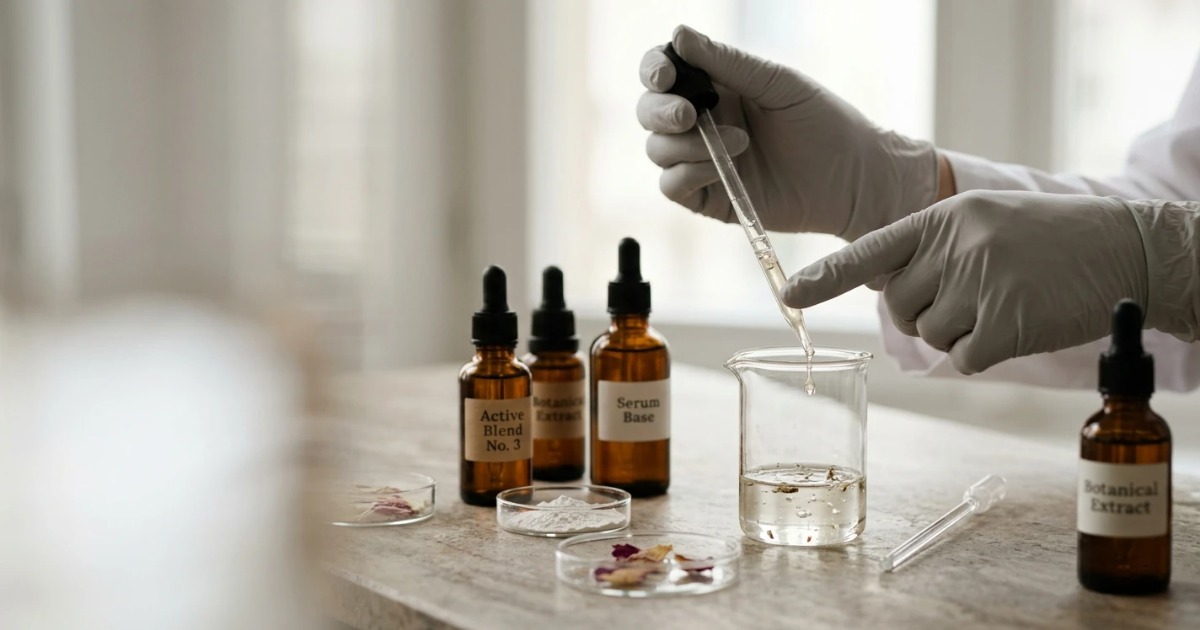
This guide is for business decision-makers who want to move past simple reselling and build a brand with staying power. We'll map the market opportunity, decode Amazon demand signals, quantify the profit potential of private label ownership, and explain why an R&D-driven manufacturing partner is the single most important choice you'll make.
Why R&D Capability Defines Skincare Success
Anyone can slap a logo on a stock cream. What they can't do is create a product customers can only buy from them. A custom skincare formulation — one with a proprietary active blend, texture, and clinical rationale — is what turns a commodity into an asset.
R&D is what turns market trends into shelf-ready products before competitors catch up. When your manufacturer runs an active laboratory, you gain the ability to iterate, differentiate, and charge premium prices. That capability runs through this entire guide.
The Global Skincare Market: Size, Growth, and Opportunity
Skincare is the largest and most resilient segment of the global beauty industry. Understanding its scale is the first step in framing your investment thesis.
Market Size and Growth Projections
Industry research consistently ranks skincare as the dominant beauty category. Its steady expansion is driven by aging populations, rising disposable income in emerging economies, and the mainstreaming of ingredient-conscious routines.
| Metric | Value / Estimate | Notes |
|---|---|---|
| Global skincare market size (2025) | ~USD 130–150 billion | Largest segment of the beauty industry |
| Projected CAGR (2025–2030) | ~5–7% | Sustained multi-year growth outlook |
| Fastest-growing segments | Anti-aging, natural/clean, active-driven | Premium and efficacy-led categories lead |
The takeaway for brand builders is clear. Demand isn't just large — it's expanding in exactly the high-margin, efficacy-focused categories where an R&D skincare manufacturer adds the most value.
Key Consumer Trends Shaping Demand
Today's buyers are more informed than ever. They read ingredient lists, follow dermatologists on social media, and expect proof behind every claim.
- Clean beauty: Transparent, non-toxic, and sustainable formulations continue to gain share.
- Active ingredients: Vitamin C, hyaluronic acid, retinol, niacinamide, and peptides drive purchasing decisions.
- Personalization: Skin-type-specific and concern-targeted products outperform generic offerings.
- Derma-cosmetics: The blurring line between clinical skincare and cosmetics rewards science-backed brands.
Regional Hotspots and Emerging Markets
North America and Europe remain the highest-value markets, where premium and clean-label products command strong margins. Asia-Pacific — led by China, South Korea, and Southeast Asia — is the fastest-growing region and a global epicenter for skincare innovation.
Amazon's Best-Selling Skincare Products: A Data-Driven Snapshot
Marketplace bestseller data gives you a real-time window into what consumers are actually buying, making it an invaluable planning tool for any new brand.
Top-Performing Skincare Categories on Amazon
| Product Category | Popularity Indicator | Average Price Range |
|---|---|---|
| Serums (Vitamin C, Hyaluronic) | High | $15–$45 |
| Moisturizers | High | $12–$40 |
| Cleansers | Medium-High | $10–$30 |
| Sunscreens | Rising | $14–$38 |
| Retinol / anti-aging | High margin | $20–$60 |
What Bestseller Data Reveals About Buyer Priorities
The patterns are instructive. Products with clearly communicated active ingredients and visible results consistently outperform generic alternatives, even at higher price points.
Reviews show that shoppers reward texture, absorption, and measurable outcomes — precisely the attributes shaped in a laboratory. It's powerful validation that formulation quality, not just marketing, drives sustainable sales.
The Private Label Skincare Opportunity: Profit and Positioning
Market demand only becomes a business when you capture the margin. Private label ownership is the mechanism that lets you keep it.
Understanding Private Label vs. OEM/ODM Models
These terms are often confused, so clarity matters. In an OEM (Original Equipment Manufacturer) arrangement, you provide the formula and the factory produces it. In an ODM (Original Design Manufacturer) model, the factory offers ready-to-brand formulations you can customize.
Private label sits on top of both — it's your brand identity applied to products made by a partner. The most powerful approach combines private label branding with custom skincare formulation, so your products are truly your own.
The Profit Margin Advantage
The economics strongly favor owning your product over reselling someone else's.
| Business Model | Typical Gross Margin | Control Over Product | Scalability |
|---|---|---|---|
| Reselling third-party | Low (10–25%) | Low | Limited |
| Private label (basic stock formula) | Medium (40–60%) | Medium | Good |
| R&D-driven private label | High (60–80%+) | Full | Excellent |
The difference isn't marginal — it's structural. A defensible formula lets you avoid price wars and build brand equity that compounds over time.
Barriers to Entry and How to Overcome Them
The obstacles are real but manageable: formulation complexity, regulatory compliance, minimum order quantities (MOQs), and quality assurance. The right manufacturing partner solves each of these most efficiently.
A capable private label skincare factory absorbs the technical and regulatory burden, freeing founders to focus on brand, marketing, and distribution.
Why R&D Should Anchor Your Manufacturing Partner Choice
If one decision sets your brand's ceiling, it's which factory you choose — and whether that factory can innovate.
The Role of a Custom Skincare Formulation Manufacturer
A generic OEM sells you the same base formula it sells everyone else. A true custom skincare formulation manufacturer employs in-house chemists who build products around your specific target customer, active ingredients, and positioning.
That distinction gives you intellectual property you can defend, a story you can tell, and results customers can feel.
From Concept to Shelf: The Product Development Lifecycle
A mature skincare product development lab moves a product through a disciplined process:
- Ideation: Defining the concept, target concern, and hero ingredients.
- Formulation: Bench development and sensory refinement of texture, scent, and efficacy.
- Stability testing: Ensuring shelf life, safety, and consistency across conditions.
- Scale-up: Translating lab success into reliable mass production.
Quality, Compliance, and Certifications That Matter
Trust is built on documentation. Look for a GMP certified skincare production facility, ISO 22716 compliance, and proven readiness for FDA, EU, and other international regulatory frameworks. These certifications are non-negotiable for marketplace approval and consumer confidence.
Why Chinese Manufacturers Lead in R&D-Focused Private Label Skincare
Perceptions of Chinese manufacturing have changed dramatically. Today, leading Chinese factories pair advanced laboratories with unmatched supply-chain depth.
Cost Efficiency Without Compromising Innovation
The strategic advantage of a China-based cosmetic contract manufacturing services is a rare combination: competitive pricing alongside sophisticated R&D infrastructure. Brands get access to modern labs and formulation talent at costs that protect their margins.
Supply Chain Maturity and Ingredient Access
China hosts one of the most complete cosmetic supply ecosystems in the world — from raw active ingredients and packaging to filling and finishing. For OEM skincare suppliers, that proximity means faster development cycles, lower costs, and greater flexibility.
How to Vet a Reliable R&D Skincare Manufacturer
| Evaluation Criterion | What to Look For |
|---|---|
| R&D lab capability | In-house chemists and active, ongoing formulation development |
| Certifications | GMP, ISO, and documented export compliance |
| MOQ flexibility | Scalable minimums for both startups and enterprises |
| Formulation portfolio | Proven, customizable base formulas across categories |
| Communication & lead times | Responsive, transparent, and reliable delivery |
Spotlight: Poleview Biotechnology Co., Ltd.
To move from theory to practice, consider a manufacturer that embodies the R&D-first philosophy this guide advocates.
Company Overview and R&D Strengths
Poleview Biotechnology Co., Ltd. is an R&D-focused custom skincare formulation manufacturer that develops science-backed products for brands worldwide. With dedicated laboratory teams and a deep library of customizable formulations, Poleview helps clients create products that are genuinely their own rather than off-the-shelf copies.
Manufacturing Capabilities and Certifications
Running GMP-standard production facilities, Poleview offers full OEM and ODM services backed by rigorous quality assurance. Its compliance readiness supports brands targeting demanding markets in the US, EU, and Asia-Pacific.
End-to-End Partnership Value
Poleview supports brand builders well beyond formulation — from concept and stability testing to packaging selection and regulatory documentation. This end-to-end model lets founders launch faster while keeping full control over their brand identity.
How to Launch Your Private Label Skincare Brand: A Step-by-Step Roadmap
Step 1 – Define Your Niche and Target Customer
Identify a specific audience and skin concern. A focused niche — such as sensitive-skin barrier repair or active anti-aging — is far easier to market than a generic line.
Step 2 – Select Your Product Line and Formulations
Use marketplace demand data to prioritize categories like serums, moisturizers, or sunscreens, then work with your lab to define hero ingredients.
Step 3 – Partner With an R&D Skincare Manufacturer
Choose a partner with proven laboratory capability and flexible MOQs. This step, using the vetting criteria above, shapes everything that follows.
Step 4 – Branding, Packaging, and Compliance
Develop your visual identity, secure compliant labeling, and finalize packaging that reflects your positioning and price point.
Step 5 – Launch, Sell, and Scale on Marketplaces
Start with focused channels such as Amazon and direct-to-consumer, gather reviews, reinvest in inventory, and expand your product range as demand grows.
Frequently Asked Questions (FAQ)
What is the minimum order quantity for private label skincare?
MOQs vary widely by product and manufacturer, often ranging from a few hundred to a few thousand units per SKU. R&D-focused factories with flexible terms — like those offered through private label cosmetics manufacturing partnerships — let startups begin at lower volumes and scale up.
How long does custom skincare formulation take?
A fully custom formulation usually takes anywhere from several weeks to a few months. That timeline covers bench development, stability testing, and refinement. Customizing an existing base formula moves faster and often wraps up within a few weeks.
Are Chinese skincare manufacturers compliant with US/EU regulations?
Top manufacturers hold GMP and ISO certifications and know how to meet FDA and EU cosmetic requirements. Always confirm documentation and export compliance before you commit to any OEM skincare supplier.
How much does it cost to start a private label skincare brand?
Your initial investment depends on product complexity, order volume, packaging, and branding. Many brands launch on a modest budget by starting with a focused product line and choosing a manufacturer that offers scalable MOQs.
What makes an R&D-focused factory better than a standard OEM supplier?
A standard OEM produces existing formulas. An R&D-driven factory creates unique, defensible products built for your brand. That difference means stronger differentiation, higher margins, and a lasting competitive edge.
Conclusion & Call to Action
The skincare market is large, growing, and increasingly rewards brands built on real formulation science. The evidence — from strong market growth to Amazon bestseller patterns — points to one strategy: own a differentiated product, protect your margins, and partner with a manufacturer that can innovate alongside you.
An R&D-focused private label skincare factory is not a cost center. It is the foundation of a profitable, defensible brand. If you are ready to turn market opportunity into a real product line, the next step is a conversation with a partner who can bring your vision to the shelf.
Contact Poleview Biotechnology Co., Ltd. today for a formulation consultation and partnership discussion — and start building a skincare brand that stands on the strength of its own science.