
The rules governing cosmetics in the United States have shifted more in the past few years than in the previous eight decades. For manufacturers, brands, contract laboratories, and regulatory affairs teams, understanding the current framework is no longer optional. It's a business-critical function.
This guide gives an authoritative, practitioner-focused overview of FDA cosmetic regulations. It covers statutory foundations, active MoCRA compliance obligations, registration workflows, labeling standards, and ingredient safety expectations. It's built for professionals who need actionable clarity, not surface-level summaries.
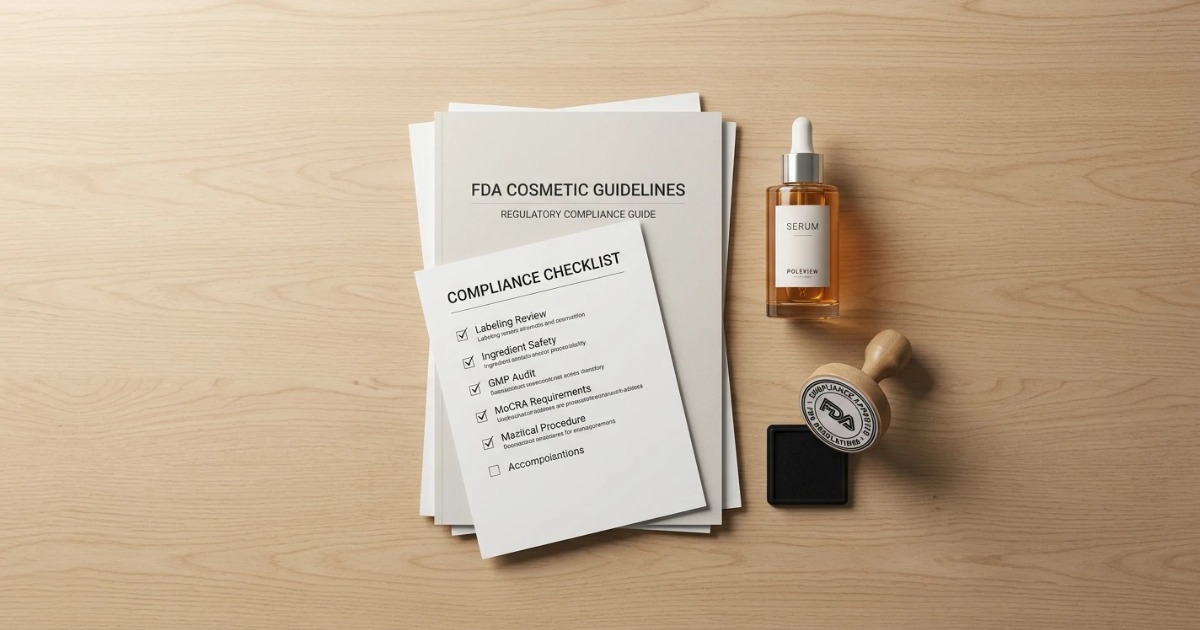
Understanding the FDA's Authority Over Cosmetics
The U.S. Food and Drug Administration regulates cosmetics under a distinct legal framework, separate from drugs, devices, and food. Historically, cosmetics faced comparatively light oversight. That dynamic has shifted substantially.
Knowing where the FDA's authority begins and ends helps professionals allocate compliance resources correctly and anticipate enforcement priorities.
The Federal Food, Drug, and Cosmetic Act (FD&C Act)
The FD&C Act is the foundational statute defining what counts as a cosmetic. Under the Act, cosmetics are articles intended to be applied to the human body for cleansing, beautifying, promoting attractiveness, or altering appearance, without affecting the body's structure or function.
The Act's two central prohibitions are adulteration and misbranding. Adulteration concerns product safety and composition. Misbranding relates to false or misleading labeling. Both remain the backbone of FDA enforcement.
Critically, the FD&C Act does not require pre-market approval for most cosmetic products or ingredients, with color additives being the primary exception. The manufacturer bears the legal responsibility to ensure products are safe and properly labeled.
How MoCRA Transformed the Regulatory Landscape
The Modernization of Cosmetics Regulation Act of 2022 (MoCRA) represents the most significant expansion of FDA cosmetic authority since 1938. Signed into law in December 2022, it introduced mandatory obligations that were previously voluntary or nonexistent.
MoCRA established requirements for facility registration, product listing, adverse event reporting, safety substantiation, and mandatory recall authority. It also directed the FDA to develop rules on Good Manufacturing Practices and fragrance allergen disclosure.
For regulatory professionals, MoCRA compliance is now the central organizing principle of cosmetic oversight in the U.S. market. The statute closed longstanding gaps and brought the U.S. closer to international norms.
Cosmetics vs. Drugs: The Critical Classification Line
The line separating a cosmetic from a drug hinges on intended use, which the FDA determines mainly through product claims. A product marketed to treat, prevent, or affect a physiological function is a drug, regardless of its appearance.
Many products occupy a dual "cosmetic-drug" status. Anti-dandruff shampoos, sunscreens, and fluoride toothpastes are common examples that must satisfy both cosmetic and drug requirements.
A moisturizer claiming to "hydrate skin" is a cosmetic. The same moisturizer claiming to "reduce wrinkles by stimulating collagen production" may be classified as a drug, triggering far more rigorous approval obligations.
Misclassification is a frequent cause of FDA warning letters. Professionals should audit marketing language across all channels, from websites and social media to packaging, to keep claims within cosmetic boundaries.
MoCRA Compliance: Core Requirements for 2026
With key statutory deadlines now behind us, MoCRA obligations are fully active and subject to enforcement. The sections that follow break down the requirements regulatory teams must maintain on an ongoing basis.
Facility Registration and Product Listing
Every facility that manufactures or processes cosmetic products for U.S. distribution must register with the FDA. Registration is submitted electronically through the FDA's Cosmetics Direct portal.
Separately, the Responsible Person must submit product listings for each marketed cosmetic. A single listing may cover multiple products with identical formulations that differ only in fragrance or color.
FDA cosmetic registration must be renewed biennially, and product listings must be updated when material changes occur. Failure to maintain accurate registration can render products misbranded.
Responsible Person Obligations
MoCRA introduced the concept of the "Responsible Person," the manufacturer, packer, or distributor whose name appears on the product label. This entity carries primary compliance accountability.
Responsible Person duties include ensuring adequate safety substantiation, keeping adverse event records, submitting reports, and ensuring accurate labeling. For imported products, pinning down the correct Responsible Person is essential, and it's sometimes settled through contract negotiation.
Adverse Event Reporting and Recordkeeping
The Responsible Person must report serious adverse events to the FDA within 15 business days of receiving the information. Serious adverse events include death, hospitalization, disfigurement, or significant disability.
Records supporting adverse event reports must be kept for six years, or three years for small businesses. Companies should also hold onto any new medical information received within one year of the initial report.
A solid intake and triage system matters here. Consumer complaints often arrive through customer service channels rather than formal regulatory pathways.
Safety Substantiation Requirements
MoCRA formalized the long-standing expectation that cosmetics be safe under labeled or customary conditions of use. Responsible Persons must keep records demonstrating "adequate substantiation of safety."
Adequate substantiation means tests, studies, or other evidence sufficient for a qualified expert to conclude the product is not injurious. This may include ingredient safety data, toxicological assessments, and stability testing.
Unlike the EU, the FDA does not require a formal Product Information File. Still, keeping organized, expert-backed documentation is the practical standard for defensible cosmetic ingredient safety.
MoCRA Compliance Deadlines and Status Overview
| Requirement | Original Effective Timeline | Current Status |
|---|---|---|
| Facility Registration | Enforcement began mid-2024 | Active — biennial renewal required |
| Product Listing | Enforcement began mid-2024 | Active — updates required for changes |
| Adverse Event Reporting | Effective December 2023 | Active — 15 business day window |
| Safety Substantiation | Effective December 2023 | Active — records must be maintained |
| Recordkeeping | Effective December 2023 | Active — 3–6 year retention |
| Fragrance Allergen Labeling | Rule proposed; finalization pending | Awaiting final rule |
| Good Manufacturing Practices | Rulemaking in progress | Proposed rule anticipated |
FDA Cosmetic Registration: Step-by-Step Process
Registration and listing may look administrative, but errors create downstream compliance exposure. The workflow below reflects practical best practices for accurate submissions.
Preparing Your Facility Registration
Before submitting, gather core facility data: facility name, physical address, contact information, and a DUNS number issued by Dun & Bradstreet. The FDA uses the DUNS number to validate facility identity.
Companies must first create an account within the Cosmetics Direct system. Foreign facilities must also designate a U.S. agent to serve as the point of contact for FDA communications.
Confirming that facility information matches the DUNS record precisely helps avoid submission rejections and delays.
Submitting Product Listings
Product listings require the product name, category, ingredient list, and the Responsible Person's details. Ingredients should be disclosed accurately, reflecting the actual formulation.
The FDA offers both single-product entry and batch submission through structured data files, which works well for large portfolios. A consistent internal product code system streamlines future updates.
Renewal, Updates, and Exemptions
Facility registrations require renewal every two years. Product listings must be updated within a defined window whenever formulations change or products are discontinued.
MoCRA provides a small business exemption from facility registration and product listing for entities below an average annual gross sales threshold. This exemption does not apply, however, to products that come into contact with the eye mucosa, are injected, are intended for internal use, or alter appearance for more than 24 hours under normal removal conditions.
FDA Registration Requirements by Business Type
| Requirement | Large Manufacturer | Small Business | Importer / Distributor |
|---|---|---|---|
| Facility Registration | Required | Generally exempt* | Required if manufacturing |
| Product Listing | Required | Generally exempt* | Responsible Person must list |
| Adverse Event Reporting | Required | Required | Required |
| Safety Substantiation | Required | Required | Required |
| U.S. Agent Designation | If foreign | If foreign | If foreign facility involved |
*Small business exemptions do not apply to higher-risk product categories described above.
Cosmetic Labeling Requirements
Labeling remains one of the most enforced areas of FDA cosmetic oversight. A technically safe product can still be deemed misbranded through labeling errors, exposing the company to detention or recall.
Mandatory Label Elements
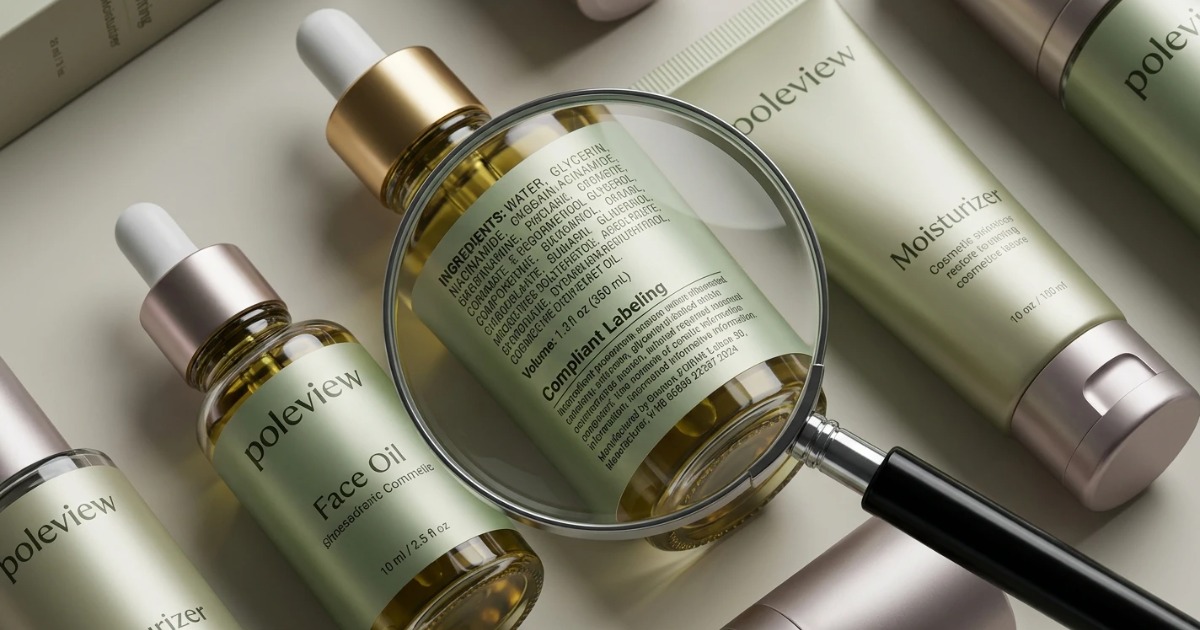
Every cosmetic label must include four core elements: an identity statement describing the product, the net quantity of contents, the name and place of business of the manufacturer or distributor, and disclosure of any material facts.
The principal display panel (PDP)—the part seen at purchase—must carry the identity statement and net quantity. The information panel typically carries ingredient declarations and business details.
Ingredient Declaration Rules
Ingredients must be listed by their INCI (International Nomenclature of Cosmetic Ingredients) names and ordered by predominance—the highest concentration comes first. Ingredients present at one percent or less may appear in any order after those above one percent.
Fragrance and flavor components can be declared collectively as "fragrance" or "flavor," though forthcoming allergen requirements are narrowing that allowance. Color additives go at the end, regardless of concentration.
Fragrance Allergen Labeling Under MoCRA
MoCRA directs the FDA to issue a rule requiring disclosure of specific fragrance allergens on cosmetic labels. This brings U.S. practice closer to EU cosmetic regulation, which has long required allergen listing.
Once the final rule takes effect, allergens previously grouped under "fragrance" will need individual identification when present above defined thresholds. Companies should start mapping fragrance formulations now to prepare for implementation.
Warning Statements and Directions for Use
Certain product categories require specific cautionary language. Aerosol products, feminine deodorant sprays, and products in self-pressurized containers all carry mandated warnings.
Products whose safety has not been adequately substantiated must bear a prominent warning stating that safety has not been determined. Where relevant, clear directions for safe use should accompany that warning.
Claims and Prohibited Language
Cosmetic claims must stay within the bounds of appearance and cleansing. Language implying therapeutic effect, disease treatment, or physiological change turns a cosmetic into an unapproved drug.
Terms such as "anti-aging" are generally acceptable when framed around appearance, but phrases like "repairs damaged cells" or "treats eczema" cross into drug territory. Regulatory review of all marketing copy is essential to compliance.
Required Label Components and Placement Rules
| Element | Required Panel | Notes |
|---|---|---|
| Identity Statement | Principal Display Panel | Common or descriptive name |
| Net Quantity of Contents | Principal Display Panel | Bottom 30% of panel, dual units |
| Name & Place of Business | Information Panel | Full address unless in directory |
| Ingredient Declaration | Information Panel | INCI names, ordered by predominance |
| Warnings / Directions | Any conspicuous panel | Legibility requirements apply |
| Material Facts | As appropriate | Must not be misleading |
Cosmetic Ingredient Safety and Restrictions
Most cosmetic ingredients require no pre-market approval, yet the FDA maintains prohibitions, restrictions, and heightened scrutiny over certain substances. Ingredient governance sits at the core of any compliance program.
Prohibited and Restricted Ingredients
The FDA prohibits or restricts a defined list of substances in cosmetics, including bithionol, mercury compounds (with narrow exceptions), vinyl chloride, halogenated salicylanilides, chloroform, and certain chlorofluorocarbon propellants.
Restricted ingredients may be permitted only under specified conditions or concentration limits. Formulators should verify current status before introducing any novel or borderline ingredient.
Color Additive Approval Requirements
Color additives are the notable exception to the no-pre-approval rule. Every color additive used in cosmetics must be approved by the FDA for its intended use, and many require batch certification.
Certified colors—typically synthetic dyes designated by FD&C or D&C numbers—must be tested and certified by the FDA for each batch. Exempt colors, generally derived from natural sources, skip batch certification but must still be approved for use.
PFAS, Talc, and Emerging Contaminant Concerns
MoCRA specifically directed the FDA to assess the use of per- and polyfluoroalkyl substances (PFAS) in cosmetics and to develop standardized testing methods for detecting asbestos in talc-containing products.
Asbestos contamination in talc has driven litigation and recalls, and the FDA has proposed standardized detection methodologies. PFAS scrutiny keeps intensifying, and several manufacturers are already reformulating ingredients ahead of anticipated restrictions.
Good Manufacturing Practices (GMP)
MoCRA requires the FDA to establish binding GMP regulations for cosmetics. Until the final rule is issued, the FDA's non-binding GMP guidance and ISO 22716 serve as the practical benchmark.
Proactive companies are aligning with ISO 22716 now, addressing documentation, sanitation, batch records, and quality control. Early adoption reduces disruption when mandatory GMP rules take effect.
High-Risk Ingredients and Regulatory Status
| Ingredient / Substance | Regulatory Status | Applicable Framework |
|---|---|---|
| Mercury compounds | Prohibited (narrow exceptions) | FD&C Act / FDA regulation |
| Bithionol | Prohibited | FDA regulation |
| Asbestos (in talc) | Contaminant — testing directed | MoCRA |
| PFAS | Under FDA assessment | MoCRA |
| Uncertified color additives | Prohibited without approval | Color Additive Amendments |
| Chloroform | Prohibited | FDA regulation |
Import and Global Compliance Considerations
Imported cosmetics make up a large share of the U.S. market, and foreign manufacturers must meet the same standards as domestic producers. Border oversight adds another layer of compliance risk.
FDA Import Alerts and Entry Requirements
Imported cosmetics get screened at entry and may be detained if they appear adulterated or misbranded. The FDA maintains import alerts that authorize detention without physical examination for products or firms with a history of violations.
Before shipment, importers must confirm that foreign facilities are registered, products are listed, and labeling meets U.S. requirements. Accurate documentation and a designated U.S. agent speed up entry.
Aligning with International Standards
The EU Cosmetics Regulation remains the most demanding global framework. It requires pre-market safety assessments, a Product Information File, notification through the CPNP portal, and detailed allergen labeling.
FDA cosmetic regulations differ in structure, but MoCRA has narrowed the gap considerably. Companies operating globally gain from a harmonized compliance system that satisfies the strictest applicable jurisdiction, cutting duplicative effort.
Enforcement, Recalls, and Penalties
MoCRA gave the FDA enforcement tools it previously lacked. Understanding these mechanisms helps professionals gauge risk and prioritize where to invest in compliance.
FDA Inspection and Recall Authority
For the first time, the FDA holds mandatory recall authority over cosmetics. If the agency determines a product is likely to cause serious adverse health consequences and the Responsible Person declines a voluntary recall, the FDA can order one.
The FDA can also inspect records related to safety substantiation and adverse events. Complaints, adverse event patterns, or import findings may trigger an inspection.
Warning Letters and Non-Compliance Consequences
Warning letters remain the most common enforcement action. They frequently cite unapproved drug claims, misbranding, or ingredient violations, and ignoring one can escalate to seizure, injunction, or import detention.
Beyond regulatory penalties, non-compliance invites reputational damage, retailer delisting, and civil litigation. The cost of remediation typically far exceeds the cost of getting compliance right upfront.
Building an Audit-Ready Compliance Program
A resilient compliance program folds registration, safety documentation, labeling review, and adverse event monitoring into one managed system. Keep documentation centralized and easy to retrieve.
- Maintain current facility registrations and product listings with scheduled renewal reminders.
- Keep organized safety substantiation files for every marketed product.
- Run a formal adverse event intake, triage, and reporting workflow.
- Conduct periodic label and claims audits across all marketing channels.
- Align manufacturing with ISO 22716 in anticipation of mandatory GMP rules.
- Track pending rulemaking, particularly fragrance allergen and GMP developments.
Treat compliance as a continuous process rather than a one-time project. That approach positions organizations to respond confidently to inspections and regulatory change.
Frequently Asked Questions
Does every cosmetic company need to register with the FDA?
Not every company, but most facilities that manufacture or process cosmetics for U.S. distribution must register. Small businesses below the defined sales threshold may be exempt from facility registration and product listing. That exemption does not extend to higher-risk product categories such as eye-area or injectable products.
What is the difference between MoCRA and the FD&C Act?
The FD&C Act is the foundational statute defining cosmetics and prohibiting adulteration and misbranding. MoCRA is a 2022 amendment that expanded FDA authority, adding mandatory registration, product listing, adverse event reporting, safety substantiation, and recall powers. MoCRA works within the FD&C Act framework rather than replacing it.
Are small businesses exempt from all MoCRA requirements?
No. Qualifying small businesses are exempt from facility registration and product listing, but they still face adverse event reporting, safety substantiation, recordkeeping, and labeling obligations. The exemption also excludes products that contact the eye mucosa, are injected, or are intended for internal use.
How do I know if my product is a cosmetic or a drug?
Classification depends on intended use, which the FDA interprets largely through claims. If your product is marketed to cleanse or beautify, it is a cosmetic. If it claims to treat, prevent, or affect the body's structure or function, it is a drug—and may require pre-market approval. Products can also hold dual cosmetic-drug status.
When do fragrance allergen labeling rules take effect?
MoCRA directed the FDA to issue a rule requiring fragrance allergen disclosure, and a proposed rule now exists. As of this period, the final rule hasn't taken effect. Prepare now: map your fragrance formulations so you can update labels quickly once the rule is finalized.
FDA cosmetic guidelines will keep shifting as pending rules on GMP and fragrance allergens move toward finalization. Professionals who build flexible, well-documented compliance systems today will adapt most easily as the rules mature.