
A quote of $0.08 per tablet looks like a win until the third production batch dissolves too slowly, leaves a chalky film in the drum, and triggers a wave of one-star reviews. That failure almost never comes from unit cost — it comes from formulation instability, undeclared active ingredients that stall at customs, and a minimum order quantity that forced you to buy 40,000 units of a product you never properly tested. By the end of this guide, a decision-maker will know how to vet a Chinese manufacturer, which specs and documents to demand, and how to structure a first order that protects both margin and brand equity.
Key Takeaways
- Formulation beats price: Stability, dissolution behavior, and disclosed actives determine reorder success far more than per-piece cost.
- Match the engagement model: Private label for speed, OEM for your spec, ODM for full custom R&D — each carries different MOQ and lead-time trade-offs.
- Demand documentation upfront: COA, SDS/MSDS, stability reports, and audit or ISO evidence should exist before mass production, not after.
- Test before you scale: Order samples, run stability and real wash-machine field tests, then confirm batch-to-batch consistency.
- Respect compliance caveats: Never market unverified efficacy; classify actives correctly under REACH/GHS for safe, legal shipping.
Why the "Cheapest Tablet Wins" Mindset Costs Brands More
First-time buyers usually rank suppliers by a single number: price per tablet. That metric hides the variables that actually decide whether your product line survives its second season.
The hidden costs behind a low per-unit quote
A cheap quote often assumes a lean formula, older tooling, or minimal documentation. The real bill arrives later — re-testing after a failed batch, shipments held because oxygen-based actives weren't declared correctly, and full rebranding when the supplier quietly changes a formula between runs.
Total landed cost includes freight, certification transfers, and the margin you lose to returns. A tablet that costs two cents more but performs consistently protects revenue that a bargain unit quietly erodes.
What a washing machine cleaning tablet actually has to do
The product has four jobs: dissolve mineral scale, lift detergent residue and biofilm from the drum and gasket, neutralize the musty odor those deposits cause, and sanitize interior surfaces. Every one of those outcomes traces back to formulation chemistry and tablet engineering — not packaging or price.
How Washing Machine Cleaning Tablets Work (Formulation Fundamentals)
Before you negotiate, understand what you're buying at the chemical level. It changes the questions you ask.
Core active ingredients and their roles
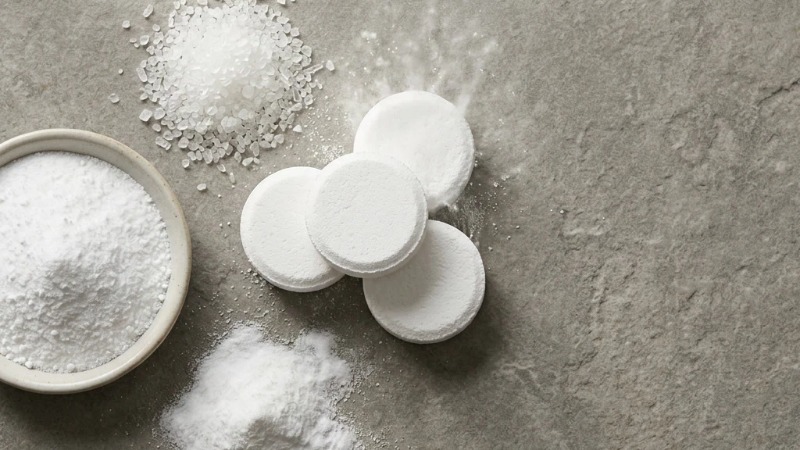
Most effective tablets combine a descaling acid, an oxygen-based bleaching agent, surfactants, and an effervescent base. Citric acid dissolves limescale; sodium percarbonate releases active oxygen to break down organic residue and odor; surfactants lift and suspend grime; sodium bicarbonate drives effervescence for even dispersion.
These ingredients are moisture-sensitive. Improper humidity control during blending or storage causes premature reaction, weakens the tablet, and shortens shelf life — one reason stability testing is non-negotiable. Handling requires ventilation and dry storage.
Effervescent vs. compressed vs. coated tablets
Effervescent tablets dissolve fast and disperse actives quickly, suiting short cleaning cycles. Densely compressed tablets dissolve slower for a sustained release. Coated tablets add a moisture barrier and can stage the release of different actives. Format also affects machine fit: front-load drums and top-load agitators expose tablets to different water volumes and flow, so dissolution speed should match the target appliance.
Eco and safety positioning
Phosphate-free and chlorine-free formulations are increasingly expected in retail cleaning ranges, and biodegradable claims can differentiate a brand — but only when substantiated. REACH registration and GHS classification determine how actives are labeled and shipped, and a Safety Data Sheet (SDS) must accompany the product. Never market efficacy or safety numbers you cannot verify with test data.
| Active Ingredient | Primary Function | Typical Concern / Caveat |
|---|---|---|
| Citric acid | Descaling / limescale removal | Acidic; store dry, keep away from bases until dosed |
| Sodium percarbonate | Oxygen bleaching, odor and residue breakdown | Moisture-reactive; requires GHS classification for shipping |
| Surfactants | Lift and suspend soils and biofilm | Type affects foaming; confirm low-foam grades for HE machines |
| Sodium bicarbonate | Effervescent base, mild abrasion | Humidity control critical during compression and storage |
Private Label vs. OEM vs. ODM: Choosing Your Engagement Model
Buyers routinely conflate these three models, then get surprised by the MOQ or timeline. Here is the practical difference.
Private label (existing formula, your brand)
You adopt a proven, ready formula and apply your own branding and packaging. It is the fastest route to market with the lowest customization and typically the friendliest MOQ — ideal for validating a new product line before committing to bespoke development.
OEM (your spec, their production)
You supply a formula or a precise performance requirement, and the manufacturer produces to it. This suits brands that already own a formulation or have exacting specs on actives, dosage, or dissolution.
ODM (their R&D, your brand and tweaks)
The manufacturer develops the product with you — efficacy, scent, color, dosage, tablet format, and packaging. ODM gives the strongest differentiation and IP position but carries higher MOQ and longer lead times because development and testing sit inside the timeline.
| Factor | Private Label | OEM | ODM |
|---|---|---|---|
| Unit cost | Lowest | Moderate | Higher (dev amortized) |
| Speed to market | Fastest | Moderate | Slowest |
| Typical MOQ | Lower | Moderate | Higher |
| Differentiation | Limited | Moderate | Strongest |
| IP control | Shared formula | You hold spec | Negotiable, often exclusive |
What to Verify Before You Sign: A Manufacturer Vetting Checklist
This is where money is saved or lost. Treat documentation and testing as gates, not formalities.
Certifications and documentation to request
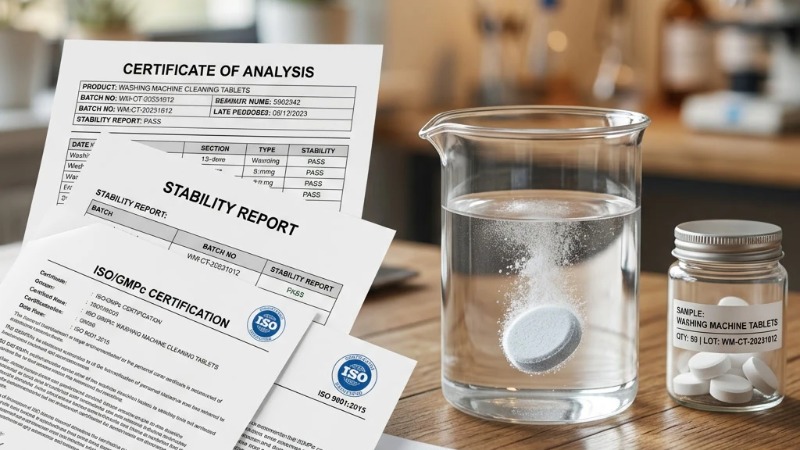
Ask by document type and know what each proves. ISO quality-system standards (such as ISO 22716, common across a manufacturer's personal-care lines) evidence process discipline. GMPc signals good manufacturing practice. An MSDS/SDS covers hazard and handling data; a COA (Certificate of Analysis) confirms a specific batch meets spec; stability reports show shelf-life behavior; audit reports verify the facility independently.
Production capability signals
Look for a dust-free workshop, automated stamping, filling, labeling, and packing lines, documented batch-consistency controls, and a defined QC sampling protocol. Photos alone prove nothing — ask for line video, batch records, and a sample drawn from a live run.
Sample and stability testing protocol
- Request production-representative samples, not hand-made prototypes.
- Run stability testing (in-house or third-party) across temperature and humidity.
- Field-test in real front-load and top-load machines for dissolution and residue.
- Place a small reorder and confirm batch-to-batch consistency before scaling.
| Document | What It Verifies | Red Flag If Missing |
|---|---|---|
| COA | Batch meets declared spec | No proof of consistency between runs |
| SDS/MSDS | Hazard, handling, transport data | Shipping and customs exposure |
| Stability report | Shelf-life and storage behavior | Unknown degradation risk |
| ISO / audit report | Quality system and facility integrity | Unverified production discipline |
Understanding MOQ, Pricing, and Packaging Options
MOQ and packaging shape your cash exposure more than the tablet price itself.
Typical MOQ tiers and how to negotiate a pilot run
MOQ generally scales with customization and packaging complexity: a stock formula in a plain tub sits at the low end, while a custom ODM formula in printed retail packaging sits higher. Negotiate a pilot run at a reduced quantity in exchange for committing to a follow-on order tied to test results — a reasonable manufacturer will meet a serious buyer partway.
Packaging and dosage formats
Common formats include tubs, blister packs, resealable pouches, and single-dose sachets. Because these tablets are moisture-sensitive, prioritize moisture-barrier packaging and, where relevant to your market, child-safety features. Label printing, from simple stickers to full retail-ready cartons, is typically configurable.
Cost drivers beyond the tablet
Budget for custom molds, fragrance and color development, packaging tooling, certification transfers, and freight. These one-time or per-SKU costs often explain why two "identical" quotes differ — one includes tooling and documentation, the other defers it to you later.
| Order Tier | Indicative MOQ Range | Customization Available | Lead Time |
|---|---|---|---|
| Pilot / test | Lowest tier, negotiable | Stock formula, basic labeling | Shortest |
| Standard private label | Moderate | Brand packaging, scent/color options | Moderate |
| Full ODM | Higher | Custom formula, dosage, retail packaging | Longest (includes R&D and testing) |
Ranges are directional; confirm exact figures with your chosen manufacturer, as they vary by formula and packaging.
Why Brands Source Washing Machine Cleaning Tablets From China
The commercial case rests on supply-chain depth and category breadth rather than price alone.
Supply-chain depth and category expansion
Household cleaning and single-dose cleaning tablets are a growing segment, with industry and market-research sources through the mid-2020s pointing to sustained consumer demand for convenient, concentrated, and eco-positioned cleaning formats. That momentum has deepened China's supplier base for effervescent and compressed tablet production.
One-stop OEM/ODM ecosystems
Many capable manufacturers also produce adjacent categories — bath bombs, shower steamers, cleaning tablets, and personal-care products — under one quality system. For a brand, that means you can build a bundled private-label range from a single vetted partner, sharing documentation, QC standards, and freight consolidation across SKUs.
Common Mistakes and Best Practices in Private-Label Sourcing
Mistakes to avoid
- Skipping stability testing and discovering shelf-life failures after launch.
- Ignoring SDS and GHS classification, then facing customs holds on shipments.
- Under-ordering samples so problems surface only at mass-production scale.
- Assuming polished photos equal real production capability.
Best practices that protect your margin and brand
- Lock the exact formula version in writing so it cannot drift between runs.
- Define QC acceptance criteria — dissolution time, hardness, weight tolerance — in the contract.
- Stage payments against milestones: sample approval, pre-production, and shipment.
- Secure all documentation (COA, SDS, stability, audit) before authorizing mass production.
Frequently Asked Questions
What's the typical MOQ for private label washing machine cleaning tablets?
MOQ varies with customization and packaging. A stock formula with basic labeling carries the lowest minimum, while custom ODM formulas in retail packaging require more. Many manufacturers, including one-stop OEM partners, will negotiate a reduced pilot run when it is tied to a committed follow-on order.
Can I request a custom formula, scent, and packaging (ODM)?
Yes. Under an ODM engagement the manufacturer develops efficacy, scent, color, dosage, and packaging to your brief. Expect a longer lead time because R&D and stability testing are built into the schedule.
Which certificates should a reputable manufacturer provide?
Request ISO quality-system evidence (such as ISO 22716 on related lines), GMPc, an SDS/MSDS, a batch COA, a stability report, and an independent audit report. Each proves a different thing, and a credible supplier can produce them before you order.
Are these tablets safe for both front-load and top-load machines?
Well-formulated tablets can suit both, but dissolution behavior and foam profile should match the appliance type. Confirm compatibility with the manufacturer and follow the product's own dosage and usage instructions rather than assuming a universal fit.
How long does a first private-label order usually take?
A stock private-label order moves fastest; OEM sits in the middle; full ODM takes longest because development and testing precede production. Build in time for sampling, stability confirmation, and a short consistency reorder before committing to volume.
How should the tablets be stored and shipped?
Store in a cool, dry, well-ventilated space in moisture-barrier packaging, since the actives are humidity-sensitive. For shipping, ensure correct GHS classification and an accompanying SDS so the consignment clears customs without delay.
Ready to Launch Your Private-Label Line?
Poleview Group — together with Boymay Cosmetics Co., Ltd. and Poleview Biotechnology Co., Ltd. — provides OEM and ODM services for custom cleaning tablets and adjacent personal-care lines, backed by dust-free automated production across stamping, filling, labeling, and packing.
Our formulations follow natural, parabens-free, and cruelty-free principles, and we supply verified documentation including GMPc, FDA, ISO 22716, MSDS, COA, stability, and audit reports. If you are ready to test a product line without over-committing capital, request samples and a quote for a pilot run, and let our team help you structure a first order that protects your margin and your brand.