
A serum that retails for $48 often costs under $4 to produce at a well-run factory in Guangzhou — and that gap is exactly why so many independent beauty brands source overseas. The catch is that the same supply chain producing world-class formulations also hosts trading companies posing as factories, paper certifications, and INCI lists that don't match what's in the bottle.
This guide is written for the decision-maker who has to reconcile that tension: real margin advantage against real regulatory and reputational risk. By the end, you will know how to vet a supplier, structure the negotiation, and protect your brand — without gambling on unverified efficacy claims or non-compliant labeling.
- Verify the factory, not the salesperson. Demand a business license, GMP/ISO 22716 evidence, and a third-party audit before discussing price.
- Match the sourcing model to your stage. White label for speed, ODM/OEM for differentiation, fully custom for defensible IP.
- Regulatory liability stays with the brand owner — not the factory — in the US (MoCRA), EU (CPNP), and China (NMPA).
- Never scale without a pilot order and independent lab testing of stability, pH, and any efficacy claim.
- The lowest quote is a signal, not a win — it usually points to substituted ingredients or an unaudited facility.
Why China Dominates Private Label Skincare Production
China is not the cheapest option for every category, but it remains the most complete one. A single industrial cluster can supply raw actives, primary and secondary packaging, filling lines, and regulatory support within a few hours' drive — a density few other regions can match.
The Scale and Supply Chain Advantage
Production concentrates in three main hubs. Guangzhou (Guangdong) is the epicenter for skincare and color cosmetics; Zhejiang and the Yangtze River Delta specialize in packaging and componentry; Shanghai anchors R&D, testing labs, and multinational-grade quality systems.
This proximity compresses lead times because a formulator, a bottle supplier, and a filling line can coordinate without cross-border shipping between steps. Global beauty market analyses through 2026 consistently point to sustained growth in the "indie" and private-label segment, with much of that supply originating from these Chinese clusters — a qualitative trend backed by trade-body and market-research reporting rather than any single headline figure.
Cost Structure vs. Domestic Manufacturing
The savings are real but specific. They come from lower labor costs, integrated packaging sourcing, and flexible minimum order quantities (MOQs) that let smaller brands access professional-grade formulations. They do not come from cutting corners on compliance — that's where hidden costs and recalls live.
Where China's cost edge narrows is in freight, import duties, third-party lab testing in your destination market, and the management overhead of remote quality control. Factor those in before comparing a Chinese unit price to a domestic one.
China vs. US/EU Contract Manufacturing (Indicative Comparison)
The ranges below are directional planning aids, not quotes. Actual terms vary by category, formula complexity, and packaging.
| Factor | China OEM/ODM | US/EU Contract Manufacturer |
|---|---|---|
| MOQ range | 500–3,000 units (some stock formulas lower) | 1,000–10,000 units common |
| Lead time | 4–10 weeks + shipping | 6–12 weeks, shorter domestic freight |
| Formulation cost | Lower; large stock-formula libraries | Higher labor and R&D rates |
| Tooling / packaging | Integrated, broad component range | Often sourced separately |
| Compliance overhead | Buyer manages destination-market filing | Some support for local regs, higher cost |
Private Label vs. White Label vs. OEM vs. ODM: Getting the Terms Right
Vendors use these terms loosely, and the confusion costs brands money. Here is the practical distinction.
Quick-Reference Definitions
- White label: A ready-made stock product you brand as your own. Fastest and cheapest; zero exclusivity.
- Private label: Often used interchangeably with white label, but typically implies more customization of packaging, scent, or minor formula tweaks under your brand.
- OEM (Original Equipment Manufacturer): The factory produces to your specification — you bring the formula or brief, they manufacture. "OEM skincare manufacturer China" usually means this build-to-spec model.
- ODM (Original Design Manufacturer): The factory designs and owns the base formula, which you customize and rebrand. Faster than full custom, less exclusive than OEM.
In practice, "private label skincare China" and "OEM skincare manufacturer China" overlap heavily — the difference is how much of the formula and design originates with you versus the supplier.
Comparison Table: Four Sourcing Models
| Model | Formula Control | Customization | Typical MOQ | Speed to Market | Best-Fit Buyer |
|---|---|---|---|---|---|
| White label | Low | Packaging only | Lowest | Fastest | Testing a market / launch on budget |
| Private label | Low–Medium | Packaging + minor tweaks | Low | Fast | Early-stage brands scaling a line |
| ODM | Medium | Base formula adjustments | Medium | Moderate | Brands wanting differentiation quickly |
| OEM | High | Full build-to-spec | Higher | Slowest | Established brands with proprietary IP |
Which Model Fits Your Brand Stage
If you're validating demand or launching lean, white label beauty products wholesale or private label gets you to shelf fastest with minimal capital. If you already have traction and need a moat, custom skincare formulation suppliers and OEM production let you own a formula competitors can't copy off the shelf.
Certifications and Regulatory Compliance You Cannot Skip
Skincare touches health claims and skin safety, so this is the section where shortcuts become liabilities. Treat certification as the gate, not a checkbox.
GMP, ISO, and Facility Standards
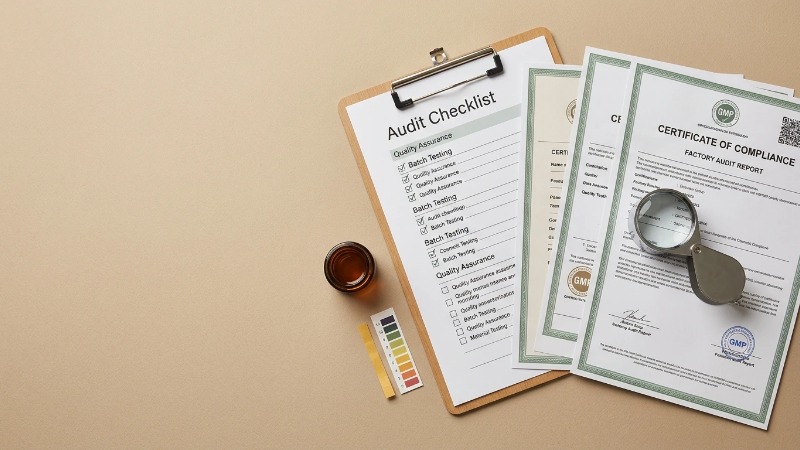
Look for GMP certified skincare production and ISO 22716, the international standard for Good Manufacturing Practices in cosmetics. Genuine certification means documented batch records, controlled environments, and traceability — not a framed certificate in the meeting room.
Verify by requesting the certificate number, issuing body, and expiry date, then confirming through the certifying organization. A factory unwilling to share auditable records is answering your question.
Formulation Safety and INCI Transparency
Insist on a full INCI (International Nomenclature of Cosmetic Ingredients) disclosure for every product. Cross-check it against restricted and banned substance lists for your target markets — the EU alone prohibits or restricts well over a thousand cosmetic ingredients.
Before scaling, commission stability testing (how the product holds up over its shelf life and across temperatures), pH testing, and preservative efficacy (challenge) testing. Patch-testing for skin irritation should precede any consumer launch.
Selling into Regulated Markets
Each destination market imposes its own regime, and the responsibility stays with you as the brand owner or "responsible person," not with the factory:
- United States: Under MoCRA (the Modernization of Cosmetics Regulation Act), facilities must register and products must be listed with the FDA, with safety substantiation required.
- European Union: Products must be notified via the CPNP portal, backed by a Product Information File and a designated EU Responsible Person.
- China: The NMPA requires registration or filing depending on whether the product is a "general" or "special" cosmetic.
Checklist Table: Certifications by Target Market
| Destination Market | Required Registration | Testing Needed | Typical Lead Time |
|---|---|---|---|
| United States | FDA facility registration + product listing (MoCRA) | Safety substantiation, stability | Weeks to a few months |
| European Union | CPNP notification + PIF + Responsible Person | Safety assessment, stability, challenge test | 1–3 months |
| China (NMPA) | Filing (general) or registration (special) | In-country testing at approved labs | Several months, longer for special |
How to Vet a Private Label Skincare Manufacturer: A Step-by-Step Process
This is the operational core. Follow it in order — each step de-risks the next.
Step 1 — Shortlist and Verify Legitimacy
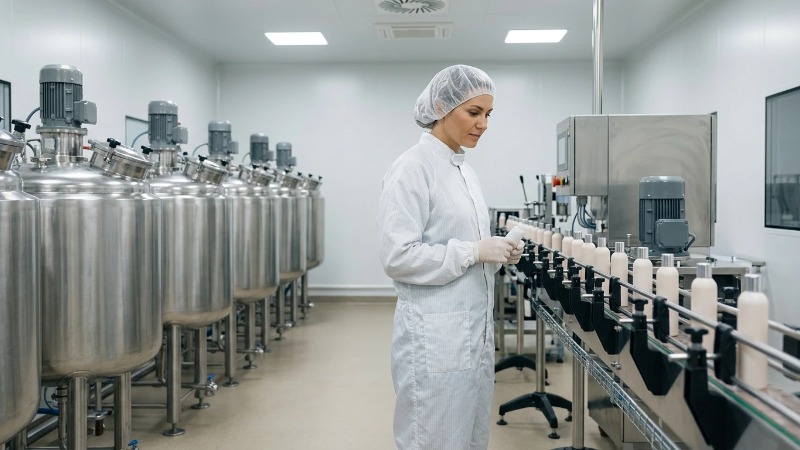
Confirm the company is a factory, not a trading company reselling someone else's production. Request the business license, verify export history, and ask for a recent third-party audit report (SGS, Intertek, or Bureau Veritas are common). A video factory tour on short notice is a good real-world signal of transparency.
Step 2 — Request Samples and Test Formulations
Evaluate texture, absorption, scent stability, color hold, and packaging compatibility. Then send samples to an independent lab to verify pH, stability, and — critically — any efficacy claim the supplier makes. Never take a performance claim on trust.
Step 3 — Assess Communication and Project Management
Measure response time, English-language fluency, and whether you get a dedicated account manager. Put an NDA and a formula-confidentiality clause in place before sharing any proprietary brief. Poor communication during courtship rarely improves after the deposit clears.
Step 4 — Clarify MOQ, Pricing, and Payment Terms
Get MOQ tiers in writing per SKU, understand deposit structure (30% deposit / 70% before shipment is common), and scrutinize the quote line by line. Red flags include prices far below market, vague ingredient specs, and pressure to skip testing to "save time."
Step 5 — Run a Pilot Order Before Scaling
A small first production run validates quality, packaging, labeling accuracy, and logistics before you commit serious capital. It also surfaces the gaps — a mislabeled INCI, a cap that leaks, a lead-time slip — while they're cheap to fix.
Pros and Cons of Sourcing Private Label Skincare from China
An honest ledger matters more than a sales pitch here.
Advantages
Lower unit costs, fast turnaround, deep packaging integration, and access to extensive existing formulation libraries let brands launch categories that would be uneconomical to develop from scratch.
Risks and Trade-offs
Quality can vary between batches and between suppliers; IP protection is weaker than in some jurisdictions; communication and time-zone gaps slow problem-solving; and shipping timelines can swing. Above all, regulatory liability stays with your brand.
Pros & Cons Table
| Advantages | Limitations |
|---|---|
| Significant unit-cost savings at scale | Batch-to-batch quality variance without tight QC |
| Fast prototyping and short lead times | Formula IP harder to protect remotely |
| Integrated packaging and componentry | Language and time-zone friction |
| Large stock and semi-custom formula libraries | Freight, duties, and testing erode headline savings |
| Flexible MOQs for smaller brands | Regulatory compliance burden stays with you |
Common Mistakes Brand Owners Make (and How to Avoid Them)
Chasing the Lowest Quote
A quote 30% under the market usually means substituted actives, diluted concentrations, or an unaudited facility. Benchmark three suppliers and treat outliers as warnings, not bargains.
Skipping Independent Lab Testing
Relying on the factory's own test data is how unsafe or non-compliant products reach shelves — and how recalls start. Independent verification is inexpensive relative to a market withdrawal or a safety complaint.
Ignoring Packaging and Fulfillment Logistics
Customs classification, market-specific labeling rules, and Incoterms (EXW vs. FOB vs. DDP) quietly determine your landed cost and legal exposure. Clarify who is responsible for what before the container ships.
Over-relying on Verbal Efficacy Claims
If a supplier says a serum "brightens in seven days," you cannot legally market that without substantiating data you own. Never advertise an efficacy or health benefit the manufacturer can't back with defensible evidence.
Cost and Timeline Expectations
Typical Cost Components
Budget for formulation or customization fees, sample rounds, mold/tooling for custom packaging, per-unit production cost, destination-market testing and registration, and freight plus duties. These are cost drivers — the totals depend entirely on your formula and volume, so treat any single number with skepticism until you have quotes.
Timeline Table: From Inquiry to First Shipment
| Phase | Typical Duration | Key Deliverable |
|---|---|---|
| Sourcing & shortlisting | 2–4 weeks | Vetted supplier list |
| Sampling & formula approval | 3–6 weeks | Approved sample + lab results |
| Packaging & tooling | 3–6 weeks | Finalized components |
| Compliance & registration | Weeks to months (market-dependent) | Market clearance |
| Production & QC | 4–8 weeks | Finished, inspected goods |
| Shipping & customs | 1–6 weeks | First shipment landed |
Frequently Asked Questions
What is the typical minimum order quantity for private label skincare in China?
For stock or white label formulas, MOQs can start around 500 units per SKU. Semi-custom and OEM production typically runs 1,000–3,000 units, with higher minimums for complex formulas or custom packaging tooling.
Are China-made skincare products safe and compliant for the US and EU?
They can be, provided the manufacturer follows GMP/ISO 22716 and you complete the required destination-market steps — FDA registration and listing under MoCRA for the US, CPNP notification and a Product Information File for the EU. Compliance depends on your diligence, not the country of origin alone.
How do I protect my formula and brand from being copied?
Use a signed NDA and confidentiality clause before sharing briefs, register your trademark in relevant markets, and consider splitting proprietary steps across suppliers. For truly novel formulations, work with a factory offering exclusivity agreements and keep sensitive know-how out of full documentation where possible.
Can I get a fully custom formulation, or only stock formulas?
Both are available. Stock and ODM base formulas are faster and cheaper; a full OEM custom formulation gives you exclusive IP but costs more, takes longer, and usually carries a higher MOQ.
How long does it take to launch a private label skincare line?
A white label launch can move in 6–10 weeks. A custom formulation with market registration more realistically spans 4–6 months, driven mainly by testing and regulatory filing timelines rather than production itself.
Next Step: Build Your Vetting Shortlist
Turn this into action. Draft a one-page vetting checklist from the five-step process above, then request sample kits from two or three audited factories so you can compare formulation quality side by side — not just quotes on paper.
If you want to compress the learning curve, book a sourcing consultation with an advisor who can validate certifications and manage QC on the ground. Every hour spent vetting up front is time and capital you won't lose to a failed batch, a compliance gap, or a recall — and it's the fastest safe route to market.