
For stylists, trichologists, and product formulators, knowing exactly how shampoo and conditioner diverge in function is the foundation of evidence-based client recommendations. This analysis breaks down formulation chemistry, clinical performance metrics, and application protocols to position the two products as complementary — never interchangeable — pillars of an effective hair care routine.
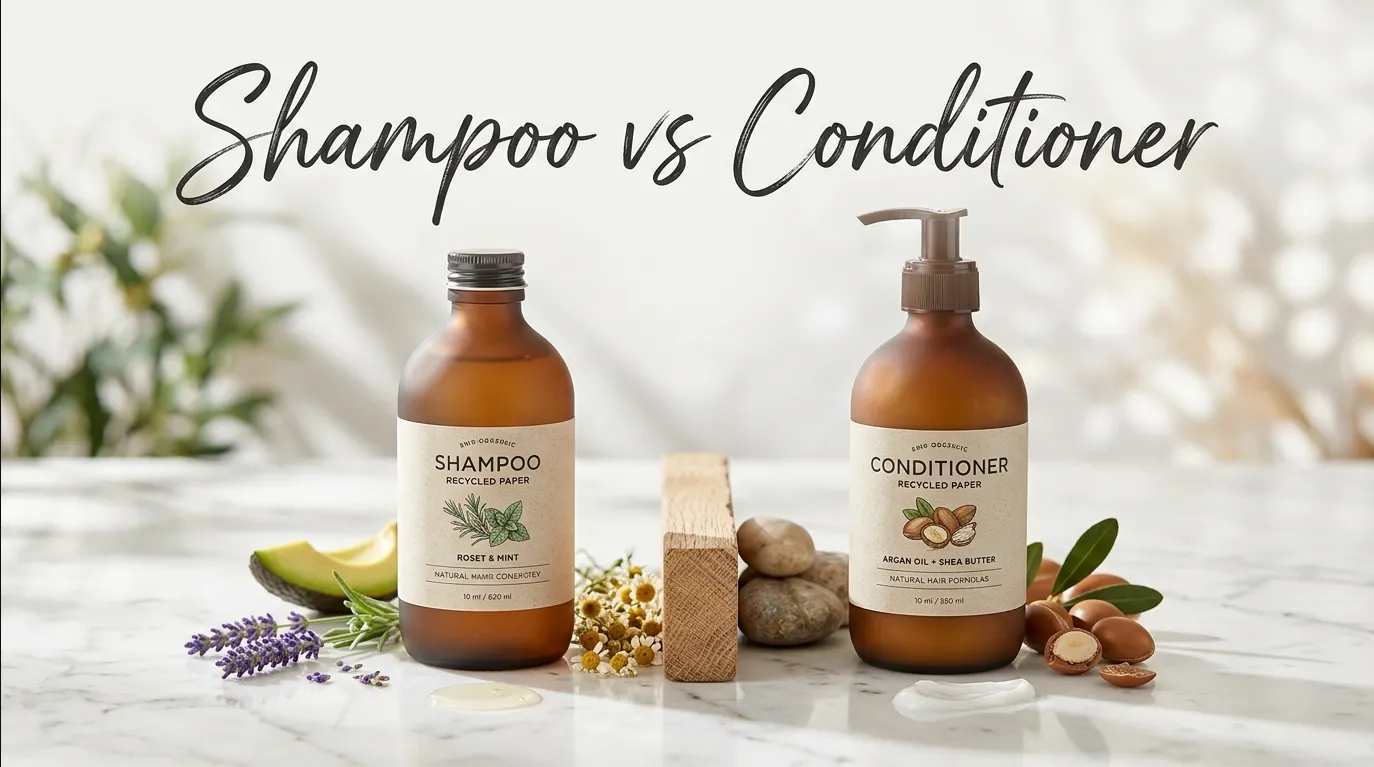
Defining the Core Distinction
Shampoo and conditioner work on opposing biochemical principles. One is engineered to cleanse; the other is engineered to deposit. Conflating their roles undermines both scalp cleansing efficacy and fiber integrity.
Primary Function of Shampoo
Shampoos are surfactant-based cleansing formulations designed to lift sebum, environmental pollutants, and accumulated product residue from the scalp and hair shaft. Their anionic surfactant system forms micelles that encapsulate oils and debris for rinse-off.
The primary target is the scalp — not the hair length. Effective sebum removal supports follicular health and prevents seborrheic conditions.
Primary Function of Conditioner
Conditioners are cationic-based treatment formulations built for hair moisturizing, cuticle smoothing, and fiber realignment. Positively charged molecules bind to negatively charged damage sites along the cuticle, restoring surface uniformity.
The target zone is mid-length to ends — areas where the fiber is oldest and most cumulatively damaged.
Why Both Are Non-Negotiable in a Hair Care Routine
The relationship is electrochemically complementary. Anionic surfactants in shampoo leave the hair shaft slightly negatively charged with a raised cuticle. Cationic conditioners neutralize that charge, flatten the cuticle, and restore hydrophobicity.
Skip either step and the deficits are predictable: omit shampoo and you get buildup and scalp dysbiosis; omit conditioner and you get friction-induced mechanical damage and moisture loss.
Formulation Chemistry: A Side-by-Side Breakdown
Active Ingredient Comparison Table
| Component Category | Shampoo | Conditioner |
|---|---|---|
| Primary Active | Anionic surfactants (SLS, SLES, Cocamidopropyl Betaine) | Cationic surfactants (Behentrimonium Chloride, Cetrimonium) |
| Typical pH Range | 4.5–6.5 | 3.5–5.5 |
| Charge | Negative | Positive |
| Key Functional Agents | Chelators, foam boosters, preservatives | Fatty alcohols, silicones, hydrolyzed proteins |
| Contact Time | 30–90 seconds | 1–5 minutes |
| Rinse Profile | Full rinse | Full rinse or leave-in |
How Surfactants Differ in Behavior
Shampoo surfactants form micelles — spherical aggregates with hydrophobic cores that solubilize sebum for water-based removal. The action is transient and rinse-dependent.
Conditioner surfactants, by contrast, exhibit substantivity: they adhere to the hair fiber through ionic attraction and resist rinsing. That deposition is what delivers measurable conditioning benefits.
The Role of Silicones, Proteins, and Humectants
Dimethicone and amodimethicone form occlusive films that reduce combing friction and seal cuticle edges. Hydrolyzed keratin and wheat proteins penetrate cortical damage sites at molecular weights below 1,000 Da.
Panthenol works as a hygroscopic agent that draws ambient moisture, while glycerin functions as a humectant equilibrating water content across the fiber.
Performance Metrics: Clinical and Sensory Outcomes
Measurable Impact Comparison
| Performance Metric | Shampoo Impact | Conditioner Impact |
|---|---|---|
| Sebum Removal Efficiency | 85–95% | <5% |
| Combing Force Reduction (wet) | 0–10% | 40–70% |
| Cuticle Smoothing | Minimal | Significant |
| Moisture Retention | Neutral to slightly negative | +25–40% |
| Static Reduction | Low | High |
| Color Longevity Support | Sulfate-free variants only | Strong protective effect |
Scalp Health vs Hair Fiber Health
The scalp is living tissue — follicular activity, sebaceous output, an active microbiome — and it needs active cleansing. The hair shaft is keratinized, non-living tissue that cannot self-repair, so it requires protective deposition.
That bifurcation explains why application zones matter: shampoo to the scalp, conditioner to mid-lengths and ends.
Damage Mitigation Capabilities
Conditioner directly mitigates mechanical damage by reducing combing force by up to 70%, lowering breakage during wet manipulation — the fiber's most vulnerable state. It also reduces chemical insult by lowering cuticle porosity post-coloring.
Shampoo's damage mitigation is indirect: by clearing oxidative residues, hard-water minerals (via chelators such as EDTA or sodium phytate), and styling product buildup, it prevents cumulative cortical stress.
When to Use Each: Professional Application Guidelines
Hair Type and Texture Matching
Fine, straight textures distribute sebum efficiently and do best with lightweight, frequent shampooing paired with low-silicone conditioners. Coarse, curly, and coily textures resist sebum migration and need lower cleansing frequency paired with high-deposition conditioning.
Medium and wavy textures sit in the middle, where customization based on porosity testing yields the best outcomes.
Frequency Protocols by Scalp Condition
| Scalp/Hair Profile | Shampoo Frequency | Conditioner Frequency |
|---|---|---|
| Oily scalp, fine hair | Daily–every other day | Mid-lengths/ends only, 2–3x weekly |
| Normal scalp, medium hair | 2–3x weekly | Every wash |
| Dry scalp, coarse/curly hair | 1–2x weekly (co-wash optional) | Every wash + weekly deep treatment |
| Color-treated hair | 2x weekly (sulfate-free) | Every wash |
| Chemically processed hair | 1–2x weekly | Every wash + bonding treatment |
Sequencing in Multi-Step Hair Care Routines
The standard professional sequence runs: cleanse (shampoo) → treat (mask, bond builder, or protein) → condition (rinse-out) → seal (leave-in, oil, or serum). Each step primes the fiber surface for optimal interaction with the next.
Flipping the sequence — conditioning before shampooing — is a legitimate technique ("reverse washing") for fine hair that goes limp easily, but it stays a niche application.
Common Misconceptions in the Industry
"2-in-1" Products: Marketing vs Reality
Two-in-one wash products try to suspend cationic conditioning agents inside an anionic cleansing matrix using complex polymer carriers, typically Polyquaternium-10 or guar hydroxypropyltrimonium chloride. The chemistry is inherently compromised: the two charge classes neutralize each other in solution.
The result? Suboptimal cleansing and suboptimal conditioning. Acceptable for travel or convenience scenarios. Never recommended as a primary protocol for clients with specific hair concerns.
Can Conditioner Replace Shampoo?
Co-washing — cleansing exclusively with conditioner — relies on the modest detergency of mild cationic and nonionic surfactants. It works well for type 3 and type 4 curl patterns, where sebum removal needs are low and moisture retention is paramount.
Limitations include cumulative buildup of conditioning agents, dulling of color-treated hair, and inadequate cleansing for clients using heavy styling products. Periodic use of a clarifying shampoo remains essential.
The Sulfate-Free Debate
Sulfate alternatives — sodium cocoyl isethionate, sodium lauroyl methyl isethionate, sodium lauroyl sarcosinate — deliver 60–80% of the cleansing efficacy of SLES with significantly reduced cuticle disruption. For color-treated, chemically processed, and sensitive scalp profiles, the trade-off favors sulfate-free.
For high-sebum scalps, oily hair, or heavy product users, traditional sulfates remain the more efficient choice. Blanket condemnation of sulfates isn't supported by current dermatological evidence.
FAQ
Is it acceptable to use only shampoo without conditioner?
For short-haired clients with low porosity and minimal styling, occasionally skipping conditioner is viable. For medium-to-long hair, chemically treated hair, or any porosity above low, omitting conditioner produces cumulative mechanical damage, increased breakage, and accelerated color fade.
Can conditioner be applied to the scalp?
Applying standard rinse-out conditioner to the scalp risks follicular occlusion, sebaceous duct blockage, and seborrheic flare-ups — particularly in clients with fine hair or active scalp conditions. Scalp-specific conditioning products formulated with non-occlusive agents are the appropriate alternative.
What is the ideal shampoo-to-conditioner ratio per wash?
Short hair (above shoulder): roughly 1:1 by volume, around 5 mL each. Medium hair (shoulder to mid-back): 1:1.5, weighted toward conditioner. Long or high-density hair: 1:2 or greater. Adjust up for coarse textures, down for fine ones.
Do shampoo and conditioner expire?
Unopened products typically hold stability for 24–36 months. Once opened, the Period After Opening (PAO) symbol — usually 6M to 12M — applies. Signs of breakdown include phase separation, color shift, viscosity loss, and rancid odor pointing to preservative failure or fatty alcohol oxidation.
Are professional-grade and drugstore formulations chemically different?
Professional formulations typically carry higher concentrations of active conditioning agents, more sophisticated surfactant blends, and premium silicone derivatives (e.g., amodimethicone vs. basic dimethicone). Drugstore formulations rely more heavily on cost-efficient sensory modifiers. The functional gap has narrowed in the masstige segment but remains measurable in clinical testing.
Should shampoo and conditioner come from the same brand line?
System-matching isn't strictly required, but it offers calibrated pH compatibility, complementary active ingredients, and predictable sensory outcomes. For clients with specific concerns — color protection, bond repair, scalp therapy — using a matched system optimizes the targeted benefit and simplifies troubleshooting.
Key Takeaways for Industry Professionals
Shampoo and conditioner aren't competitive products. They're sequential, electrochemically opposite tools targeting distinct anatomical zones. Shampoo serves the scalp through anionic detergency; conditioner serves the fiber through cationic deposition.
Professional recommendations should be guided by scalp condition, fiber porosity, chemical history, and lifestyle factors — not by marketing categories. Frequency, sequencing, and application zone matter as much as the product selection itself.
For industry professionals, the strongest position is to frame these products as complementary pillars within an evidence-based hair care protocol, with each one selected, dosed, and applied according to measurable, client-specific parameters.